Cover of Surely Joking, Mr. Feynman!

Surely Joking, Mr. Feynman!

Richard P. Feynman

Read: February 2, 2025 — Rating: 6/10

Richard Feynman’s memoir “Surely You’re Joking, Mr. Feynman!” reveals a Nobel Prize-winning physicist who was as famous for his mischievous antics as his scientific brilliance.

From picking locks in Los Alamos during the Manhattan Project to playing bongo drums in a Brazilian samba band, Feynman consistently defied the stereotype of the serious, socially awkward scientist. His irreverent approach to life—whether cracking safes, frequenting strip clubs, or pulling pranks on colleagues—was inextricably linked to his creative scientific mind.

The book suggests that genius and eccentricity often feed each other in a virtuous cycle. Feynman’s refusal to be constrained by social conventions gave him the freedom to think beyond scientific conventions as well.

Cover of Educated

Educated

Tara Westover

Read: February 2, 2025 — Rating: 7/10

Tara Westover’s memoir isn’t just about getting an education – it’s about the painful process of understanding that your reality is real, even when everyone around you denies it. It’s about unlearning and relearning everything you thought you knew.

The story begins in the mountains of Idaho, where Westover grows up in a family preparing for the end times. No birth certificate, no school, no doctors. Just the mountain, the junkyard, and her father’s increasingly paranoid worldview. Her description of this world is vivid – the smell of gasoline and metal in her father’s scrapyard, the herbs her mother stores in mason jars, the constant fear of the government coming to take them away.

It reminded me of the concept of “sensemaking” we often discuss in product management – how humans construct meaning from their experiences. Westover had to become her own ethnographer, studying the world she grew up in while simultaneously trying to escape it.

There’s a moment in the book when Westover, now at Cambridge University, learns about the Holocaust for the first time. Her professor assumes she’s making a sophisticated point about historical revisionism when she asks if everyone knows about this event. This scene captures something essential about education – how it’s not just about acquiring knowledge, but about realizing what you don’t know you don’t know.

Her journey from mountain isolation to Cambridge and Harvard isn’t a simple rags-to-riches story. It’s messier, more complex. Education becomes both salvation and separation. Each book she reads, each idea she encounters, drives a wedge between her and her family. It’s the price of seeing the world differently – you can never unsee it.

The concept of education in Westover’s memoir goes beyond formal schooling. It’s about learning to question, to doubt, to examine. In product development, we talk about “strong opinions, weakly held” – the ability to believe something firmly while remaining open to being wrong. Westover had to learn this skill not just for building products, but for reconstructing her own reality.

It’s a reminder that the ability to learn, to change your mind, to admit you might be wrong – these aren’t just academic skills.

Cover of Bed of Procrustes

Bed of Procrustes

Nassim Nicholas Taleb

Read: January 15, 2023 — Rating: 6/10

Some quotes that I liked from the book:

“The cure for modernity is to punish the least competent and most intolerant of uncertainty” - Taleb’s inversion of traditional expertise hierarchy. Modern example: COVID pandemic showed epidemiologists with zero accountability outperformed by ER nurses with skin in the game.

“You never convince anyone by argument; they convince themselves through experience” - Explains why financial warnings fail. 2008 crisis survivors became risk-averse, while textbook economists kept promoting flawed models. Pain > theory.

“A prophet is not someone with visions, but someone who remembers what others forget” - Ancient Judean drought survival techniques now used in Israeli agriculture. Modern “innovation” often rediscovery of antifragile wisdom.

“Bureaucracy is a construction by which a person is conveniently separated from the consequences of their actions” - Pentagon’s 2022 audit failure vs. Roman legion system where engineers slept under bridges they built.

“The difference between technology and slavery is that slaves are fully aware they aren’t free” - Smartphone users check devices 96x/day yet deny addiction. Compare to tobacco executives smoking while denying cancer links.

Cover of Happy City

Happy City

Charles Montgomery

Read: January 15, 2025 — Rating: 6/10

Some ideas that I liked from the book:

The Proximity Premium: Montgomery reveals how physical distance between daily needs creates “dissatisfaction loops” - the average American spends 19% of their income and 100 minutes daily just moving between life components. Compact neighborhoods slash this “spatial tax.”

The 20-Minute City Concept: Drawing from Portland and Melbourne experiments, the book shows neighborhoods designed so all basic needs (groceries, schools, parks) lie within 20-minute walk/bike ride. These residents report 32% higher life satisfaction than sprawl-dwellers.

The BMW Effect: Luxury car interiors are designed for isolated comfort, creating what Montgomery calls “mobile living rooms” that psychologically distance drivers from street life. This explains why SUV owners are 27% less likely to support pedestrian infrastructure.

Sensory Overload in Urban Design: Barcelona’s superblocks demonstrate how limiting traffic to 10km/h transforms streetscapes - the brain processes pedestrian-scale environments (3-20kph speeds) as social spaces rather than threat zones.

The Smell Map Hypothesis: Studies show people subconsciously associate citrus and baked goods smells with neighborhood safety. Rotterdam’s “aroma zoning” policies actively use this in high-crime areas.

The Smiling Index: Researchers found a direct correlation between spontaneous public smiling rates and urban happiness metrics. Cities with >18 smiles/hour (Copenhagen, Melbourne) consistently rank highest in quality of life surveys.

Playborhoods: The book documents “adult playgrounds” in Seoul and Helsinki where office workers swing and slide during lunch breaks. These spaces boost workplace productivity by 22% through micro-doses of spontaneous joy.

Gossip Geometry: Public benches angled at 120 degrees (versus traditional 90) in Vancouver’s Granville Island increased stranger conversations by 400%. The slight angle creates perceived “social permission” for interaction.

The Bus Stop Effect: Transit shelters designed for lingering (with art, seating, greenery) rather than mere waiting reduce perceived commute stress by 60%. Stockholm’s “station societies” program turned shelters into mini-libraries and plant exchanges.

Miswanting Urbanism: A behavioral economics concept applied to city planning - people think they want bigger homes/yards but adapt to them quickly while perpetually underappreciating the joy boost from daily social infrastructure.

Cover of Atomic Habits

Atomic Habits

James Clear

Read: February 2, 2025 — Rating: 9/10

The best way to understand habits is to view them as compound interest for your behavior. Just as Warren Buffett’s wealth grew exponentially through decades of compounding returns, our daily actions compound into the person we become. James Clear articulates this in Atomic Habits, drawing parallels between financial compounding and behavioral compounding.

I’ve been learning about this compounding nature of habits ever since I noticed my own writing practice evolving. When I first started blogging, each essay felt like pulling teeth. But with consistent daily writing, even just 30 minutes each morning, the words began to flow more naturally. The practice compounded. What started as painful became pleasurable.

Clear frames this transformation through the lens of identity. Rather than focusing on outcome-based goals like “I want to write a book,” he advocates for identity-based habits: “I am a writer.” This subtle shift resonates deeply with my own journey. Instead of viewing my daily writing as a checkbox to tick, I began seeing it as an expression of who I am. The writing wasn’t something I had to do, but rather something that emerged naturally from my identity.

But identity alone isn’t enough. Clear introduces what he calls the “Four Laws of Behavior Change” - make it obvious, make it attractive, make it easy, and make it satisfying. Think of these as the fundamental forces of habit formation, like gravity or magnetism in physics. Just as understanding physical laws helps engineers build bridges, understanding these behavioral laws helps us architect better habits.

I see parallels here with the design patterns I encounter in product management. Just as we create user interfaces that make desired actions obvious and friction-free, we can design our environment to make good habits the path of least resistance. It’s why I keep a notebook by my bedside for morning pages, why I disabled social media notifications, why I track my habits in Roam Research.

My favourite insight from Clear’s work isn’t about habits at all - it’s about systems. As he puts it, “You do not rise to the level of your goals. You fall to the level of your systems.” This resonates with my experience building products. The best product managers don’t just set ambitious targets; they build robust systems that make success almost inevitable.

I’ve noticed this in my own life too. When I committed to learning Ruby on Rails in 2024, setting a goal wasn’t enough. I needed a system - daily practice sessions, coding challenges, project deadlines. The system, not the goal, determined my success.

Clear’s work feels particularly relevant in our current era of constant distraction and instant gratification. In a world optimized for engagement rather than intentionality, designing good habits becomes an act of resistance. It’s about creating personal systems that align with our long-term interests rather than short-term dopamine hits.

The beauty of atomic habits lies in their smallness. Just as atoms combine to form molecules, which in turn form everything in our physical world, tiny habits compound to create the architecture of our lives. It’s not about radical transformation but about modest, consistent improvement - 1% better each day.

This perspective has changed how I approach change in my life. Instead of seeking dramatic overhauls, I look for atomic improvements.

Cover of Skin in the Game

Skin in the Game

Nassim Nicholas Taleb

Read: January 15, 2015 — Rating: 8/10

Some ideas that I liked from the book:

Ancient rulers like Assyrian kings led charges wearing 60lbs of iron armor, embodying “soul in the game” (Taleb’s upgrade to skin). Contrast with modern CEOs whose golden parachutes float while companies burn - a 2023 study showed 78% of Fortune 500 leaders had zero personal financial exposure to corporate failures.

The book traces how risk asymmetry created fragile systems: medieval lords dining with troops vs. Pentagon officials eating separately from soldiers. Modern equivalent: 2008 bankers’ OPCB (Other People’s Convexity Bets) where profits privatized, losses socialized.

Talmudic sages mandated dissenting opinions be recorded verbatim, institutionalizing doubt. Compare to IMF economists prescribing austerity while personally insulated from consequences - modern dogmatists who’ve never smelled bankruptcy’s breath.

The “bal tashchit” prohibition against wanton destruction (Deut 20:19) evolved into risk-aware ethics: medieval rabbis forbade speculative investments exceeding 1/3 net worth. Skin in the game made abstract morality concrete - lose your shirt if your financial advice fails.

Academic economists who’ve never run a lemonade stand dictating market policies, versus the Venetian merchant system where trade commissioners personally guaranteed state debts with their family fortunes. Taleb’s “megalopsychos” ideal - those whose wisdom scales with their exposure.

The book’s term for those who claim to know everything but have never tasted failure. Taleb’s “fragilistas” - those who’ve never smelled bankruptcy’s breath.

Cover of Prophet

Prophet

Khalil Gibran

Read: January 15, 2025 — Rating: 9/10

Some ideas that I liked from the book:

“Your children are not your children” - The Prophet’s radical redefinition of parenthood as stewardship rather than ownership. Parents are the bows from which life’s arrows are launched, but the target belongs to eternity. This mirrors quantum entanglement - intimately connected yet fundamentally separate destinies.

“When love beckons, follow though his ways are hard and steep” - The book’s treatment of love as an alchemical force that demands total surrender. Not the Hallmark version of romance, but a transformative fire that burns away illusion. Reminiscent of neural pruning - love destroys weaker connections to strengthen core pathways.

“You would know the secret of death, but how shall you find it unless you seek it in the heart of life?” - Death framed as life’s continuity rather than its opposite. The metaphor of the standing pool versus flowing stream - what appears terminal is merely transformational. Modern physics echoes this through energy conservation laws.

“Let there be spaces in your togetherness” challenges our cultural obsession with enmeshment. The healthiest bonds, like covalent chemical bonds, allow individual atoms to retain their electron clouds while sharing orbital space.

Grief as Unrequited Love - The Prophet suggests mourning is love persisting beyond its physical container, like light from dead stars still reaching us. This anticipates modern grief theory’s concept of continuing bonds rather than detachment.

Cover of Beginning of Infinity

Beginning of Infinity

David Deutsch

Read: February 2, 2025 — Rating: 8/10

This book was first recommended in Naval Ravikant’s Almanack. I didn’t give this book enough attention, until I came across the joint podcast of Naval with David Deutsch on the Tim Ferris show. I have always thought of epistemology as a dry boring philosophy topic, but only after coming across this work did I actually realise the gravity of this topic.

Everything ultimately boils down to epistemology. The way we organise our “justified true beliefs” gives us a lot of insight on what we perceive around the universe. For a thinking person, it’s quite important to get this correct. Without this, all our logics, debates and conclusions fall down just like a house of cards.

Critical Rationalism - Deutsch’s central epistemological framework - argues that knowledge progresses through conjectures and refutations rather than inductive verification. This turns traditional epistemology on its head: instead of seeking to “justify” beliefs, we should vigorously attempt to falsify them while proposing increasingly better explanations.

The power lies in its inversion of cognitive effort. Where others try to support their views with evidence, critical rationalism demands we:

  1. State claims boldly and precisely (no “it depends” hedges)
  2. Actively seek contradictions in existing explanations
  3. Replace flawed theories with more error-resistant ones - not as final truths, but better approximations

This creates an anti-fragile thinking system. Consider scientific theories: Newtonian physics wasn’t “proven true” - it survived intense criticism until relativity offered superior explanatory power. The theories we keep are those that withstand our most creative attempts to destroy them.

Applied personally, this means:

  • Treat all beliefs as temporary containers (even this one)
  • When encountering conflicting information, don’t rationalize - let the contradiction break your current understanding
  • Build mental models that thrive on criticism rather than collapse under it

Debates become error-correction sessions. You’re not defending positions, but stress-testing them. As Deutsch notes: “Problems are inevitable, but problems are soluble.” The solution to any flawed belief isn’t defensive certainty, but a better belief that explains more while resisting refutation.

This framework makes you a merciless thought editor. You’ll catch yourself thinking “What evidence would make me abandon this position?” before getting attached to ideas. Over time, you develop epistemic grit - the ability to hold beliefs strongly while remaining eager to discard them for superior alternatives.

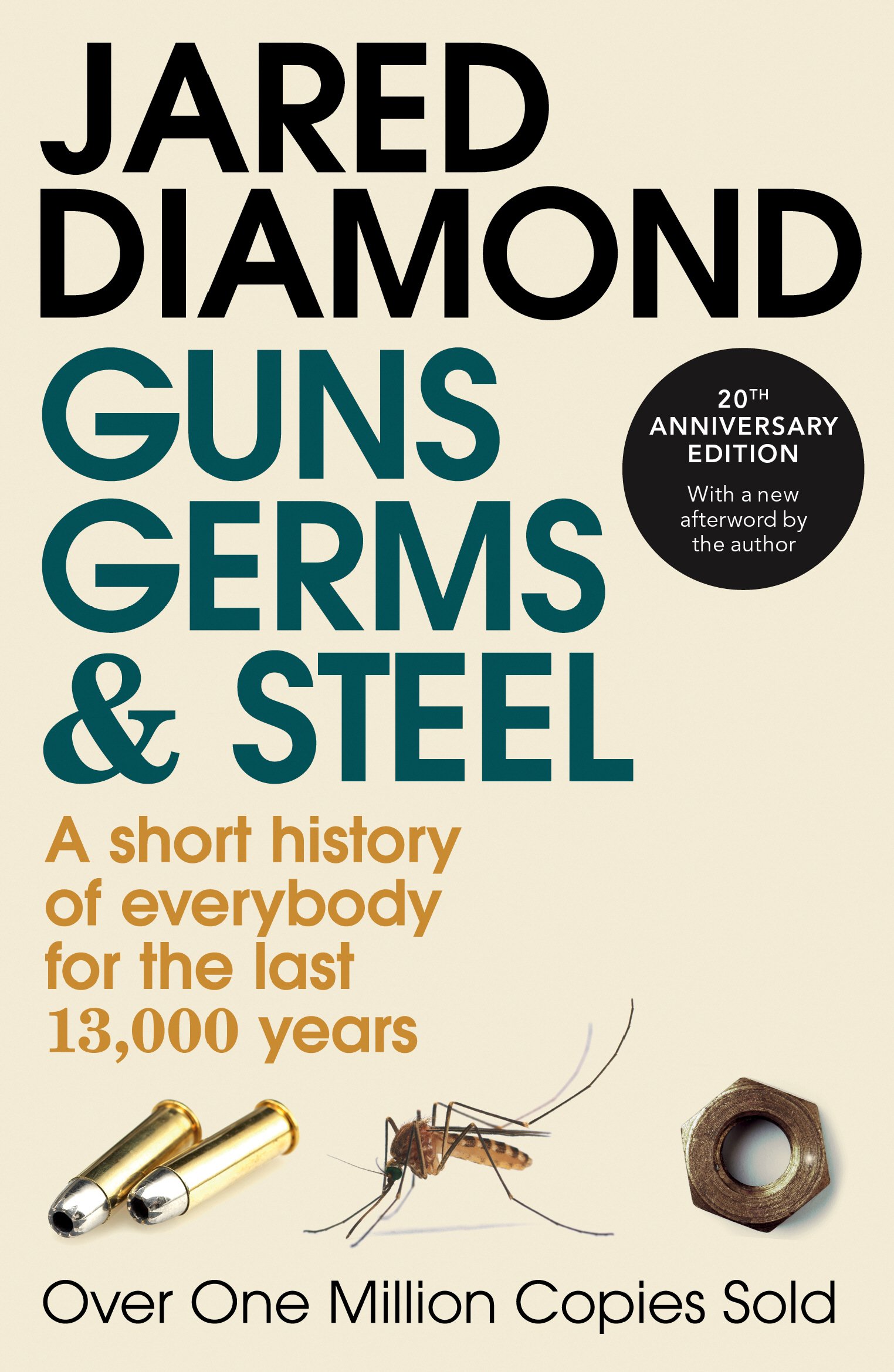
Cover of Guns, Germs, and Steel

Guns, Germs, and Steel

Jared Diamond

Read: January 15, 2023 — Rating: 8/10

The Eurasian Advantage - Diamond argues that Eurasians had a unique combination of factors that allowed them to dominate the world:

Guns - The development of advanced weaponry gave them a military advantage over other regions.Germs - The spread of diseases like smallpox and measles decimated native populations in the Americas and Australia. Steel - The ability to produce steel allowed for the construction of large and powerful ships, which gave them control of the oceans.

I didn’t find the prose as engaging as other books I’ve read, but the content is still very interesting.

Cover of Butter

Butter

Yuzuku Asako

Read: August 23, 2025 — Rating: 6/10

Some thoughts from reading this book:

  • In Malayalam, we call it as “kaipunyam” (aka the taste of one’s own hand). Some humans have this knack to make the food they make essentially tasteful; even for simple meals.

“Back in their university days, Reiko had often come over to cook in the Hatanodai apartment where Rika lived with her mother. Both Rika and her mother were astonished to discover what a good cook Reiko was. Even when making simple meals like ochazuke or pasta, her little additions of yuzu rind or salted lemon displayed her inventiveness, giving her dishes the sort of taste that made you want to take your time savouring them.”

  • Planning to make a simple dish sometime which just involves japanese rice, soy sauce, and butter. Will it be delicious?

“For a moment, Rika failed to process Kajii’s words, and she let out a quiet, ‘Hm?’ ‘Add butter and soy sauce to freshly cooked rice. Even someone who doesn’t cook can manage that much, I’m sure. It’s the best meal to truly understand the glory of butter.’ Her manner of delivery was so grave that it made it impossible to even think of ridiculing her. ”

  • The narration of cool butter on warm rice:

“‘The butter should still be cold. Remove it from the fridge just before. Superior-quality butter should be eaten when it’s still cold and hard, to truly luxuriate in its texture and aroma. It will begin to melt almost immediately with the heat of the rice, but I want you to eat it before it melts fully. Cool butter and warm rice. First of all, savour the difference in their temperatures. Then, the two will melt alongside one another, mingle together, and form a golden fountain, right there inside your mouth. Even without seeing it, you just know that it’s golden – that’s the way it tastes. You’ll sense the individual grains of rice coated in butter, and an aromatic fragrance as if the rice were being fried will ascend to your nose. A rich, milky sweetness will spread itself across your tongue …’”

“The first thing Rika felt was a strange breeze emanating from the back of her throat. The cold butter first met the roof of her mouth with a chilly sensation, contrasting with the steaming rice in both texture and temperature. The cool butter clashed against her teeth, and she felt its soft texture right down into their roots. Soon enough, just as Kajii had said, the melted butter began to surge through the individual grains of rice. It was a taste that could only be described as golden. A shining golden wave, with an astounding depth of flavour and a faint yet full and rounded aroma, wrapped itself around the rice and washed Rika’s body far away.”

  • Soy sauce, mochi and a slice of butter:

“‘Etchan was saying that a kid she works with sprinkles sugar and soy sauce on her toasted mochi, and finishes it off with a slice of butter. Don’t you think that’s disgusting? Apparently it’s how the younger generation like to eat them these days.’ ‘Butter, eh …’ Rika felt the inside of her cheeks puckering, and saliva welling up slowly in her mouth. She knew by now that the taste of butter in combination with any kind of carbohydrate was one of inexplicable fullness. There was no way that the trick wouldn’t work with mochi too. Rika washed her hands then arranged the smooth, pre-cut mochi dusted with rice flour inside the toaster. ”

  • Ramen is best tasted from a regular chain restaurant, not the air-conditioned one:

“‘Is it the cold that makes a bowl of ramen from a regular chain restaurant taste that good?’”

“Across from him, Reiko was slurping a bowl of noodles. ‘It’s my culinary speciality: Sapporo Ichiban salt ramen with butter on top. It looked like she didn’t have much of an appetite earlier. For once, she asked.’”

  • If a chef is making a turkey roast, they would be defrosting the turkey in the fridge, and not outside. This whole process takes three days. If you do it outside, it damages the outer skin of the turkey.

“Rika had initially been imagining cooking the turkey as an extension of her research, but she soon gave up on the idea. According to Madame’s notes, a 5-kilogram turkey took three whole days just to defrost. Once it was defrosted, you had to prepare it, leave it overnight, and then roast it for three hours, keeping watch over it all the while. ”

  • Roasted turkey for Christmas is probably the most difficult of the dishes to prepare. There is a high chance there might be food poisoning especially since the stuffing comes in contact with the raw meat.

“Soon enough, steam began to seep out of the vents in the rice cooker. Breathing in the smell of the umami-rich rice mixture, Rika felt the tension building. According to the food blogs and articles she’d read, stuffing a turkey brought with it the danger of food poisoning, because the stuffing came into contact with the raw meat. The important thing in that regard was to make sure that the meat was cooked through – yet if you focused exclusively on that, the whole thing may end up dry. She’d read that so long as you made sure to stuff it just before cooking, not too tightly, and basted the turkey with butter as you were cooking, you would probably be fine, but Rika was very conscious of the fact that she was cooking for nine people. Not only that, but it was mid-summer, and there was a small child. If anything bad happened, it would be on her.”

Cover of Three body problem

Three body problem

Cixin Liu

Read: February 2, 2025 — Rating: 9/10

Liu takes familiar scientific concepts and stretches them until they snap, creating something entirely new yet unnervingly plausible. The sophons – these protons unfolded into two dimensions and etched with circuitry – represent one of the most fascinating thought experiments in modern science fiction. It’s the kind of idea that makes you pause and think, “Wait, could this actually work?”

The concept of sophons delves into the intriguing overlap of quantum mechanics and computational theory. Although fictional, they are grounded in real principles of quantum superposition, where a single entity can exist in multiple states simultaneously, and dimensional manipulation, which allows for the exploration of alternate realities.

The sophons here serve not just as surveillance devices; they’re weapons of mass disruption, designed to halt scientific progress by making fundamental research impossible.

The historical backdrop of China’s Cultural Revolution, the persecution of scientists during this period isn’t just historical context – it’s a reflection on how societies can turn against knowledge itself. When Liu describes physicists being paraded through streets wearing dunce caps, it’s not just world-building. It’s a reminder of how fragile the enterprise of science can be in the face of political upheaval.

But it’s the “dark forest” theory that haunts me most. Liu suggests that civilizations in the universe remain silent not out of inability to communicate, but out of a survival instinct. The logic is chilling in its simplicity: in a universe of limited resources, any civilization you encounter is either a potential threat to be eliminated or a victim to be subjugated. The safest strategy is to stay hidden and strike first if discovered.

This theory reframes our understanding of the Fermi Paradox – why haven’t we encountered alien life? Perhaps the universe isn’t empty. Perhaps it’s like a dark forest where every civilization is a hunter hiding in the trees, holding their breath, afraid to make a sound. It’s a perspective that makes our constant broadcasting of signals into space feel suddenly naive.

Liu’s portrayal of first contact differs radically from Western science fiction traditions. There’s no Independence Day heroics, no Close Encounters wonder. Instead, we get a subtle infiltration that plays out over decades, manipulating human society through its own divisions and weaknesses. The Trisolarians don’t need invasion fleets when they have sophons and human collaborators.

Cover of Continuous Discovery

Continuous Discovery

Teressa Torres

Read: February 2, 2025 — Rating: 7/10

The book focuses on the question “what to build”, which can be daunting looking at the universe of possible options. Teresa Torres provides practical and concrete methodologies to clarify a problem and structure the opportunity space.

Several concepts will be familiar to those already following her blog. However there is tremendously value she provides by strongly articulating the goal of each method and at which stage of the discovery cycle to use them.

Cover of Righteous Mind

Righteous Mind

Jonathan Haidt

Read: April 2, 2025 — Rating: 8/10

It took me a long time to realize that arguments we argue about — aren’t always about facts. They are about values.

Reading Jonathan Haidt’s The Righteous Mind made this clearer that: be it liberals or conservatives, or activists or traditionalists — they’re all wired with different moral priorities—care, fairness, loyalty, authority, sanctity.

They feel different things are sacred. What seems obviously right to one clan feels intuitively wrong to another.

My partner and I had taken the Haidt’s moral foundations questionnaire together recently, and it was fun to see the contrast of responses in some of the questions: we both cared about fairness and compassion—but whenever I leaned toward equity, she leaned more towards loyalty and cultural continuity. Interesting!

Neither of us was wrong, but we realised we had different inner compasses. And without naming those differences, we mistook friction for betrayal.

Cover of Antifragile

Antifragile

Nassim Nicholas Taleb

Read: January 15, 2015 — Rating: 10/10

Some ideas that I liked from the book:

The Hydra Principle - Taleb’s favorite metaphor for antifragility: cut off one head, two grow back. Real-world application: Switzerland’s militia system where losing soldiers in WWII made their defense strategy stronger. Modern militaries became fragile by avoiding small conflicts.

Ethics of Public Contempt - Taleb’s unorthodox approach to criticism as volatility exposure therapy. By publicly shaming “fragilistas” and IYIs (Intellectual Yet Idiots), he practices what he preaches - systems that gain from others’ attempts to suppress them.

Fat Tony vs. Dr. John - The fictional characters that break every nonfiction rule. Tony the street-smart loan shark understands true risk better than the Nobel-winning economist. Their dialogues read like Plato’s Republic meets Goodfellas.

Switzerland as Antifragile Organism - No natural resources but 500 years of stability through armed neutrality and canton system. Their “fractal governance” - 26 mini-countries under one flag - makes them thrive on others’ crises. Compare to Singapore’s “antifragile dictatorship” model.

The Lindy Effect as Time’s Crucible - What doesn’t kill Shakespeare makes him stronger. The 400-year-old play outperforms AI-generated scripts through cultural natural selection. TikTok dances? Lucky to last 400 hours.

Via Negativa Urbanism - Ancient cities became antifragile by subtraction: Roman aqueducts outlast modern water systems. Compare to Jane Jacobs’ “eyes on the street” emerging from unplanned urban interactions vs. Le Corbusier’s fragile utopias.

Skin in the Game as Moral Antifragility - The Prophet Muhammad’s “not one of you” speech to merchants predates Wall Street’s bonus culture. Taleb argues the 2008 crisis was predictable - bankers using Other People’s Convexity Bets (OPCB).

Biological Barbells - Evolution’s strategy: 99% conservative DNA replication + 1% wild mutation. Modern life inverted this - 99% novelty chasing (TikTok, crypto) + 1% actual risk-taking. Result: cultural obesity.

The Turkey Illusion - 1000 days of farmer-fed bliss =/= safety. Thanksgiving is a black swan. Modern equivalent: VC-funded startups confusing subsidized growth for real market fitness.

Antifragile Aesthetics - Medieval cathedrals gained beauty through repeated damage/repair cycles (see Venice’s ongoing restoration). Compare to Dubai’s fragile skyscrapers - pristine until first major sandstorm.

Cover of Outliers

Outliers

Malcolm Gladwell

Read: February 2, 2025 — Rating: 8/10

Through case studies ranging from Canadian hockey players to software billionaires, Gladwell demonstrates how hidden advantages like birthdate clusters (the “Matthew Effect”), intergenerational cultural legacies (like rice farming’s work ethic), and historical timing (the 1975 personal computer revolution) create fertile ground for outlier success.

While popular culture reduced this to simplistic self-help, Gladwell’s original analysis shows how access to specialized training environments (like Bill Gates’ unique access to a time-sharing terminal in 1968) and cultural permissions (Jewish lawyers benefiting from 1970s changes in corporate litigation) transform raw effort into world-class expertise. This aligns with your writing on compound systems - true mastery emerges when deliberate practice meets institutional support structures and temporal luck windows.

What makes Outliers particularly valuable is its framework for analyzing success ecosystems. The “three lessons of Joe Flom” chapter could be read as a playbook for: 1) Identifying demographic troughs (post-Depression birth years creating smaller competition pools) 2) Leveraging disadvantage as training (Flom’s outsider status honing takeover expertise) 3) Riding cultural/technological wavefronts (1970s corporate governance changes).

When combined with your work on network effects and opportunity capture, these principles form a powerful lens for strategic life design.

Cover of Moonwalking with Einstein

Moonwalking with Einstein

Joshua Foer

Read: February 2, 2025 — Rating: 8/10

Joshua Foer’s Moonwalking with Einstein dismantles the myth of photographic memory, revealing instead that exceptional recall is a trainable skill rooted in ancient mnemonic techniques.

Through his journey from journalistic observer to U.S. Memory Championship competitor, Foer demonstrates how methods like the “method of loci” (associating information with spatial locations) and absurdist imagery (like his titular Einstein moonwalking visualization) leverage our brain’s evolutionary wiring for spatial navigation and emotional experiences. What makes this particularly compelling is how these techniques transform abstract information into vivid mental movies - where grocery lists become slapstick comedies unfolding in childhood homes, and numerical sequences morph into surreal landscapes populated by memorable characters.

The true power of Foer’s approach emerges when combined with modern spaced repetition systems (SRS) like those outlined in your Virtuoso Guide. While memory palaces create indelible initial impressions, SRS acts as a cognitive maintenance crew - systematically reinforcing these mental constructs at optimal intervals. Imagine using Anki to periodically test your recall of a chemical elements memory palace: the system prompts you to mentally walk through your grandmother’s house, retrieving mercury from the dripping faucet in her bathroom and gold from the jewelry box on her dresser. This synergy between creative encoding (Foer’s domain) and systematic reinforcement (your SRS framework) creates what Foer calls “a whole new operating system for thought.”

Ultimately, the book challenges our digital-age learned helplessness about memory, arguing that memorization isn’t obsolete but rather a fundamental tool for deep understanding.

When paired with your guide’s compound interest approach to knowledge retention, Foer’s techniques become particularly potent - they transform SRS from mere rote repetition into an imaginative practice.

Cover of Days at the Morisaki Bookshop

Days at the Morisaki Bookshop

Yuzuku Asako

Read: August 23, 2025 — Rating: 4/10

Feel good, fast read.

“There’s one thing I want you to promise me,” he said first as a preamble. Then he said, “Don’t be afraid to love someone. When you fall in love, I want you to fall in love all the way. Even if it ends in heartache, please don’t live a lonely life without love. I’ve been so worried that because of what happened you’ll give up on falling in love. Love is wonderful. I don’t want you to forget that. Those memories of people you love, they never disappear. They go on warming your heart as long as you live. When you get old like me, you’ll understand. How about it—can you promise me?”

Cover of Fooled by Randomness

Fooled by Randomness

Nassim Nicholas Taleb

Read: January 15, 2020 — Rating: 8/10

Some ideas that I liked from the book:

Taleb’s critique of post-hoc financial analysis. 2008 crisis “explanations” ignored the role of black swan events, similar to explaining lightning strikes as Zeus’s anger.

Weight vs. wealth distributions. No human will weigh 1,000kg, but tech billionaires can exceed GDPs of nations. Yet we apply Mediocristan statistics to stock markets.

The narrative fallacy in action. Cuban Missile Crisis “resolution skills” vs. probabilistic luck - remove 3mm of missile fuel pipe corrosion and we praise diplomacy.

Survivorship bias in tech: 1,000 failed startups birthed Zoom, but we only study the winner. Like crediting lottery winners’ “strategies”.

92% of day traders quit within 2 years, yet financial media interviews the 8% “geniuses”. Compare to 17th century alchemists documenting only successful experiments.

Cover of Algorithms to Live By

Algorithms to Live By

Brian Christian and Tom Griffiths

Read: January 15, 2023 — Rating: 6/10

Some ideas that I liked from the book:

The 37% Rule of Optimal Stopping - When evaluating options sequentially (apartment hunting, hiring, dating), examine 37% of possibilities as exploration phase before committing. The traveling salesman’s secret - mathematically proven to maximize probability of best choice while avoiding analysis paralysis. I apply this to time management: 37% of allocated time for research before decision-making.

Exploit/Explore Triage - The book’s restaurant selection algorithm: try new places 37% of dining occasions, return to known favorites otherwise. My adaptation - 3 months exploring new productivity methods before locking in routines. Surprisingly aligns with quarterly planning cycles in tech.

Antifragile Applications - While the rule assumes static options, I modify it for dynamic environments by treating the 37% as volatility buffer. Job searching: reject first 37% of offers not to find “the one”, but to calibrate market reality against expectations. Contrast with modern “swipe right” culture that optimizes too early.

Cover of India after gandhi

India after gandhi

Ramachandra Guha

Read: January 15, 2023 — Rating: 7/10

I started reading this more recently, right after the Independence day celebrations to know more about my great country. All that we’ve studied in the history textbooks has also been as if history came to an end with the 1947 Independence story, but there is much more color, and dimention to this:

The educationist Krishna Kumar writes that ‘for Indian children history itself comes to an end with Partition and Independence. As a constituent of social studies, and later on as a subject in its own right, history runs right out of content in 1947 … All that has happened during the last 55 years may filter through them easly civics syllabus, popular cinema and television; history as formally constituted knowledge of the past does not cover it.’13 If, for Indian children, history comes to an end with Independence and Partition, this is because Indian adults have mandated it that way. In the academy, the discipline of history deals with the past, while the disciplines of political science and sociology deal with the present.

Usually we talk about race, gender, and religion while talking about groups. In India, it’s also a bit more complicated as the caste-wise prejudices still remain:

These conflicts run along many axes, among which we may – for the moment – single out four as pre-eminent. First, there is cast, a principal identity for many Indians, defining whom they might marry, associate with and fight against. ‘Caste’ is a Portuguese word that conflates two Indian words: jati, the endogamous group one is born into, and varna, the place that group occupies in the system of social stratification mandated by Hindu scripture. There are four varnas, with the former ‘Untouchables’ constituting afifth (and lowest) strata. Into these varnas fit the 3,000 and more jatis, each challenging those, in the same region, that are ranked above it, and being in turn challenged by those below.

Would never forget this quote by Nehru, at the stroke of the midnight hour…

The star turn, however, was that of the first prime minister of free India, Jawaharlal Nehru. His speech was rich in emotion and rhetoric, and has been widely quoted since. ‘At the stroke of the midnight hour, when the world sleeps, India will awake to life and freedom,’ said Nehru.5 This was ‘a moment which comes but rarely in history, when we step out from the old to the new, when an age ends, and when the soul of a nation, long suppressed, finds utterance’.

The partition was quite a challenge for the Sikhs, as they had their holy city (Amritsar) on the East (India), and the birthplace of the founder of their religion in the west (Pakistan)..

Forced to choose, the Sikhs would come down on the side of the Hindus. But they were in no mood to choose at all. For there were substantial communities of Sikh farmers in both parts of the province. At the turn of the century, Sikhs from eastern Punjab had been asked by the British to settle areas in the west, newly served by irrigation. In a matter of a few decades they had built prosperous settlements in these ‘canal colonies’. Why now should they leave them? Their holy city, Amritsar, lay in the east, but Nankana Saheb (the birthplace of the founder of their religion) lay in the west. Why should they not enjoy free access to both places?

How Menon had to massage various rules in the fiefdoms after Independence to join with India as one country..

P. Menon with the substance. In his book, Menon describes in some detail the tortuous negotiations with the rulers. The process of give and take involved much massaging of egos: one ruler claimed descent from Lord Rama, another from Sri Krishna, while a third said his lineage was immortal, as it had been blessed by the Sikh Gurus.

While Ambedkar had led the drafting of the Indian constitution, it was the individual, not the village that was chosen as the unit..

Ultimately it was the individual, rather than the village, that was chosen as the unit. In other respects, too, the constitution was to look towards Euro-American rather than Indian precedents. The American presidential system was considered and rejected, as was the Swiss method of directly electing Cabinet ministers. Several members argued for proportional representation, but this was never taken very seriously. Another former British colony, Ireland, had adopted PR, but when the constitutional adviser, B. N. Rau, visited Dublin, Eamon de Valera himself told him that he wished the Irish had adopted the British ‘first-past-the-post’ system of elections and the British cabinet system. This, he felt, made for a strong government. In India, where the number of competing interest groups was immeasurably larger, it made even more sense to follow the British model.

Once we gained independence, Ambedkar had suggested to withdraw from means of protest such as satyagraha which were unconstitutional, and could be considered as a means of anarchy.. especially when the citizens had constitutional means to make their protest visible..

Ambedkar also assured the House that the federalism of the constitution in no way denied states’ rights. It was mistaken, he said, to think that there was ‘too much centralization and that the States have been reduced to Municipalities’. The constitution had partitioned legislative and executive authority, but the Centre could not on its own alter the boundary of this partition. In his words, ‘the Centre and the States are co-equal in this matter . Ambedkar ended his speech with three warnings about the future. The first concerned the place of popular protest in a democracy. There was no place for bloody revolution, of course, but in his view there was no room for Gandhian methods either. ‘We must abandon the method of civil disobedience, non-cooperation and satyagraha popular protest’. Under an autocratic regime, there might be some justification for them, but not now, when constitutional methods of redress were available. Satyagraha and the like, said Ambedkar, were ‘nothing but the grammar of anarchy and the sooner they are abandoned, the better for us’

How India planned to divide the responsibilities between the union, state, and in some cases, both:

The constitution provided for three areas of responsibility: union, state and concurrent. The subjects in the first list were the preserve of the central government while those in the second list were vested with the states. As for the third list, here centre and state shared responsibility. However, many more items were placed under exclusive central control than in other federations, and more placed on the concurrent list too than desired by the provinces. The centre also had control of minerals and key industries. And Article 356 gave it the powerto takeovera state administration on the recommendation of the governor.

When the Election Commision was tasked with the act of marketing the universal right to vote, and to call every Indian to come to a polling both and cast their vote, cinemas, radios and documentaries were used to communicate the importance of this act:

Throughout 1951 the Election Commission used the media of film and radio to educate the public about this novel exercise in democracy. A documentary on the franchise and its functions, and the duties of the electorate, was shown in more than 3,000 cinemas. Many more Indians were reached via All-India Radio, which broadcast numerous programmes on the constitution, the purpose of adult franchise, the preparation of electoral rolls and the process of voting.

On the Tungabhadra dam..

In the book, there is a particularly fine description of the construction of the Tungabhadra dam. When finished, the dam would embody 32 million cubic feet of masonry; these laid at the rate of 40,000 cubic feet a day, every day for five years. The sheer scale could properly be conveyed only by means of analogy. ‘Imagine the masonry in Tungabhadra Dam’, wrote Hart, ‘being laid as a highway, 20 feet wide, 6 inches thick. It would extend from Luck now to Calcutta, or from Bombay to Madras.’37 Without question the most prestigious of all these schemes was the Bhakra–Nangal project in northern India. Again, its scale is best narrated in numbers. At 680 feet, the Bhakra dam was the second highest in the world; only the Grand Coulee Dam, on the Colorado river, was higher.

Cover of Origin of Consciousness in the Breakdown of the Bicameral Mind
Origin of Consciousness in the Breakdown of the Bicameral Mind

Oliver Sacks

Read: January 15, 2023 — Rating: 8/10

Some ideas that I liked from the book:

Jaynes’ radical theory: humans until ~1000 BCE lacked conscious introspection, instead experiencing “divine voices” as commands from a right-brain “god” chamber to left-brain executive function. Consciousness emerged when linguistic metaphors collapsed the divide — a neural civil war recorded in ancient texts.

The Iliad’s heroes act on external divine commands without internal monologue. Odysseus marks the transition — first Greek hero with proto-consciousness. Compare to Abraham hearing God’s voice vs. later prophets’ internal dialogues. Schizophrenia as vestigial bicamerality?

Challenges the assumption that consciousness is evolutionarily innate. If true, rewrites human history: consciousness as recent cultural adaptation to societal complexity, not biological given. Modern implications — are our “inner voices” just evolved hallucinations?

Why no physical evidence in brain structure? How do children “relearn” consciousness each generation? The theory’s beauty vs. its gaps — like Darwin without genetics. My struggle: reconciling Jaynes’ textual analysis with neuroscience’s hard boundaries.

Cover of Antimimetics

Antimimetics

Nadia Asparouhova

Read: August 23, 2025 — Rating: 6/10

  • Not all viral ideas are good, and not all good ideas are viral. All good ideas go viral eventually, and the most important ideas seem to be hidden in plain sight, tunnelling downwards towards the earth’s crust.

“But the most valuable ideas did seem to wend their way out of the dirt, however slowly, propelled by their ability to captivate people’s attention. Not all viral ideas were good, but all good ideas seemed to go viral eventually. Now, though, the most important ideas seemed to be tunneling downwards, deeper into the Earth’s crust, like a rare and precious diamond, where no one could find them – and this was by intention. How was it possible that the most bespoke ideas had become resistant to memetic spread? And how did they still manage to spread between groups, while also avoiding public channels?”

  • Certain class of ideas that are resistant to spread are called as anti-mimetic ideas. A better analogy to explain how antimimetic ideas are hidden in plain sight is through the story of China Mieville’s The City and the City chronicles. In this fictional story, there exists two cities in the same location; those who are trained to see one city, are bound to ignore the other.

“CHINA MIÉVILLE’S THE CITY & THE CITY chronicles the fictional story of two cities, Besźel and Ul Qoma, which exist in the same physical location. Their citizens live in a state of perpetual cognitive dissonance, having been trained from birth to “unsee,” or ignore, the people, buildings, and events in the other city. They live, eat, work, and sleep in parallel societies, never noticing that the other exists. This tacit social agreement is enforced by a shadowy organization, known as Breach, whose members are permitted to perceive both cities and watch for transgressions. For all other residents, acknowledging the other city is considered a serious crime.”

  • Group chats are incubation centres for antimimetic ideas. Once they are incubated, and get transmitted within this in-group, they slowly trickle upwards into the larger discourse of the internet (social media). The mass-scale internet (such as Facebook, Instagram etc) can be considered as the national highway/expressway, whereas the group chats on Telegram/whatsapp can be considered as the suburbs with less connectivity. Controversial ideas are first introduced in such digital suburbs to ensure they survive, and then slowly, they can be introduced to the public squares where they have higher chances of getting cancelled.

“We read links that are too fiery to discuss on public feeds, so we share them in our group chats instead. We tumble down YouTube rabbit holes, peering deeper into the abyss, until we find ourselves caught in the crosshairs of a stranger who is ranting and raving about frogs or tankies or the longhouse or nazbols – obscure online microtrends that never quite break into the mainstream. We subscribe to newsletters about things we’re too embarrassed to tell others we want to know about: COVID conspiracy theories, what women really think, my self-help journey to eternal bliss. It’s tempting to classify some of these ideas as memetic, given how they transfix certain, smaller communities. But what makes these ideas antimemetic is how they propagate: in semi-private settings. You don’t bring these ideas up at work, or at the family dinner table.”

“And yet, as journalist Sophie Haigney writes in The New York Times, group chats have clearly replaced “backroom meetings among powerful media figures” as the modern successor to “the proverbial smoke-filled room.”

“Group chats are like social islands. As fast as the internet’s public highways might be, ideas evolve even more rapidly in private online environments. Ideas are tested, iterated upon, and refined, with little outside influence to temper the process, as they adapt to the unique dynamics of their members – much like Darwin’s finches.”

  • Came across this activist group drawing their attention towards attention (as ironic as it sounds)

“OUR ATTENTION IS BORN FREE, but is, increasingly, everywhere in chains,” declared a trio of activists in a New York Times op-ed.[39] Graham Burnett, Alyssa Loh, and Peter Schmidt are members of the Friends of Attention collective, a network of “collaborators, colleagues, and actual friends” that formed in 2018 due to shared concerns that our attention is being hijacked for others’ private gain.”

“I first encountered attention activism when I read Jenny Odell’s book, How to Do Nothing, less than a year before the COVID-19 pandemic began. Odell, an artist and activist based in Oakland, California, frames “doing nothing” as an act of political resistance to what’s often called the attention economy, or the buying and selling of attention in a market, like that between advertisers and media properties.””

  • The importance of a “truth-teller” for exposing anti-mimetic ideas, and bringing it to the status of a “supermeme”. No one wants to be the first-person to do this, as there is a significant risk in “revealing your hand” when it comes to such exposure. Therefore, the truth-teller holds a significant position that they bring it forward, and it carries more weight when done by a respectful outsider who has no personal agenda to do the same.

“A respectful outsider – someone who is perceived as lacking a personal agenda – often carries special gravity. Consider Jane Jacobs, who criticized top-down urban planning approaches in the 1950s, claiming that they were unnatural to how people really lived and operated in cities. Jane Jacobs explicitly lacked formal credentials: she did not have a college degree, and she was often derided by her opponents as a housewife. But it was her lack of credentials that paradoxically made her critiques ring more true. The experts claimed they had studied urban planning and therefore knew what was best for city-dwellers. Jacobs, by contrast, simply used her eyes to look around and describe what she saw, and found that reality was quite different. While both the urban planners and Jacobs could be classified as outsiders, those who push their own agenda – as Jacobs argued the urban planners were doing – often face resistance. They are seen as acting in their own interest, rather than the group’s. In order to play the role of truth-teller, an outsider must reflect the community’s values. This purity of intent is not always confined to the childlike or feminine. In Liu Cixin’s The Dark Forest, humans are trying to find a way to survive an impending invasion from Trisolaris, an alien civilization. Because the Trisolarans can read all human communication, but not private thoughts, the United Nations appoints four individuals to be “Wallfacers,” whom they task with each devising a strategy in their minds to defeat the Trisolarans. While three of the Wallfacers have prestigious political and scientific backgrounds, the fourth Wallfacer, Luo Ji, is a lazy, degenerate professor with no obvious accolades. At first, Luo rejects his responsibilities, using his new role selfishly to acquire status and power. But in the end, it is Luo who uncovers an insight that everyone else has overlooked, which leads him to devise the eponymous “dark forest” strategy.”

Cover of We should all be feminists

We should all be feminists

Chimamanda Ngozi Adichie

Read: February 2, 2025 — Rating: 8/10

Adichie describes how women are taught to shrink themselves, to make themselves smaller. I’ve seen this play out in product meetings - how female colleagues sometimes prefix their insights with “I might be wrong, but…” or “This may be a silly idea…” When male colleagues present the same ideas without these qualifiers, they’re often received differently.

Adichie tells a story about being class monitor in primary school - not because she earned it, but because she was a girl and the teacher assumed the role should go to a girl. It’s these small, everyday moments that reveal how gender roles are quietly enforced. Like water to fish, we often don’t notice these patterns until someone points them out. The author’s Nigerian perspective adds depth to the conversation. She describes how marriage becomes a measure of success for women but not for men, how women are expected to dampen their ambitions to protect male ego. These aren’t just Nigerian issues - they’re global patterns dressed in local customs.

She’s not interested in abstract discussions about patriarchy. Instead, she talks about concrete things: why do we teach girls to aspire to marriage but not boys? Why do we praise men for doing basic parenting tasks that we take for granted when women do them? The book made me reflect on my own implicit biases. Like when I assume a CEO is male unless told otherwise, or how I might perceive the same behavior differently depending on whether it comes from a male or female colleague. These aren’t comfortable reflections, but they’re necessary ones.

Adichie’s argument is simple: culture can change, and it should. She points out how her grandmother’s experience of gender was different from her mother’s, and her mother’s from hers. Each generation questioned certain assumptions that the previous one took for granted. It’s a reminder that what we consider “traditional” is often just what we’ve grown used to.

One passage that stuck with me was about how we raise boys. “We teach boys to be afraid of fear, of weakness, of vulnerability,” she writes.

The power of “We Should All Be Feminists” lies in its accessibility. Adichie isn’t writing for gender studies scholars - she’s writing for everyone. She’s saying that feminism isn’t about hating men or rejecting femininity. It’s about wanting a fairer world for everyone.

Walk into any corporate meeting, look at any company’s leadership team, or scroll through comments on any female leader’s social media, and you’ll see these patterns are very much alive. They’ve just gotten better at hiding.

Cover of Elephants on the Brain

Elephants on the Brain

Frans de Waal

Read: January 15, 2023 — Rating: 8/10

Some ideas that I liked from the book:

De Waal’s elephant studies reveal conscious self-presentation - when subjects recognized themselves in mirrors, they began practicing “social cosmetics” like rearranging dirt patterns on their skin. Proof that signaling isn’t just instinctual but involves meta-cognition. Genius framing: our LinkedIn profiles are just digital versions of pachyderm dust baths.

Documented cases of matriarchs “comforting” lower-ranking elephants actually reinforce hierarchy through performative empathy. Parallel to human virtue signaling - the book shows how altruistic acts often carry hidden status agendas. De Waal’s genius: exposing philanthropy’s evolutionary roots in primate politics.

While humans evolved complex lies, elephants’ low-frequency rumbles contain biologically uncounterfeitable stress markers. The book argues this explains why human leaders developed ceremonial robes - to compensate for lackinS authentic status signals. Brilliantly inverts typical “humans vs animals” comparisons.

The study of elephant graveyards reveals sophisticated cultural transmission mechanisms. Matriarchs lead their herds to ancestral burial grounds they visited only once as calves, decades earlier. De Waal connects this to human oral traditions and collective memory - both species evolved neural hardware for maintaining social knowledge across generations. His controversial take: modern digital archives may actually weaken our natural memory capabilities.