Brew your ideas lazily

Leonardo da Vinci’s masterpiece, the Mona Lisa achieved through the painstaking application of countless gossamer-thin layers of oil paint over the course of many years, many months. The sfumato technique which Da Vinci popularised, involved applying more than 40 layers of paint, each only 10 to 50 micrometers thick, using fingers to blend the colors and create the depth of illusion. The creation process was “perpetually unfinished” — He began the portrait around 1503, but didn’t complete it till his death in 1519. And it would be foolish to dismiss him as a ‘master procrastinator’ — What if the attribute of delayed procrastination in itself had some merit? I’m beginning to suspect that this was the hidden reason behind the genius of Mona Lisa. The art of brewing ideas lazily.
In 2009, a review of three dozen studies conducted by researchers of Lancaster University concluded that setting aside a problem was helpful in improving the performance of divergent thinking tasks.
Most creative people have figured out a way to do the incubation thing—whether it’s meditation or staring out the window or taking long walks so their ideas can percolate,” Jung says. “It’s finding that magic space where you’re not actively engaged with the external world, and not just surfing the Internet.”
In a 2009 review of more than three dozen studies of incubation, researchers from Lancaster University found that setting aside a problem was helpful for improving performance on divergent thinking tasks. Yet some methods may be better than others, they discovered. The trick appears to be engaging your mind, but just a little bit. The researchers found tasks that required a low mental investment, like reading, were most beneficial to the problem-solving process. Mentally demanding tasks like counting backward were less helpful—and surprisingly, plain old rest was also less effective at boosting divergent thinking.
Along the same lines (now backed by some evidence from research studies), I was curious to cultivate a process where I could organise my creative experiments across various themes in the form of a ‘backburner’ which could slowly brew and bring some ideas to fruition.
As a cultivating essayist, I organised my rough drafts in the form of a simple Kanban board to put the rough drafts which were to be brewed. I would just dump them even if they were not so concrete yet. All that mattered at that given moment was some form of a ‘full-body resonance’, or even vibes in general.
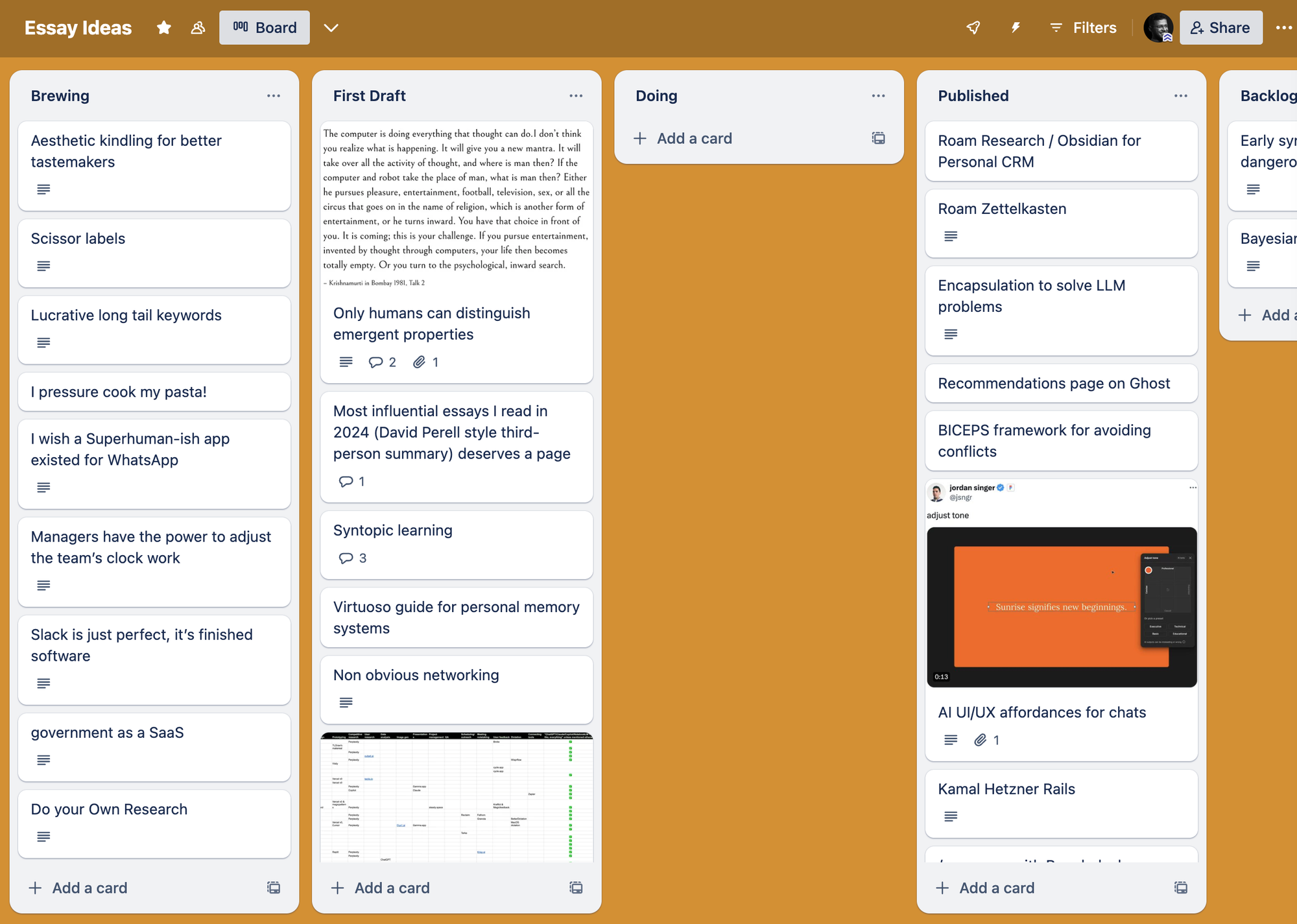
I would go ahead to bookmark/collect them. And when I went ahead with my daily chores and a general existence of life, I would start seeing patterns around me that I could connect with my backburner of ideas. Slowly, I start jotting them as and when I could. And the ideas slowly get more shape and form. And when they were ripe enough, I would then start penning them down in one full swing, almost one-shotting them.
The process worked well for essay drafting that I then start applying it towards other themes where ‘delayed procrastination’ could make me more creative. I was sometimes, a bit skeptical about this process — What if it was my mind trying to rationalise the fact that I was lazy and wanted a theory that could support my inherent laziness?
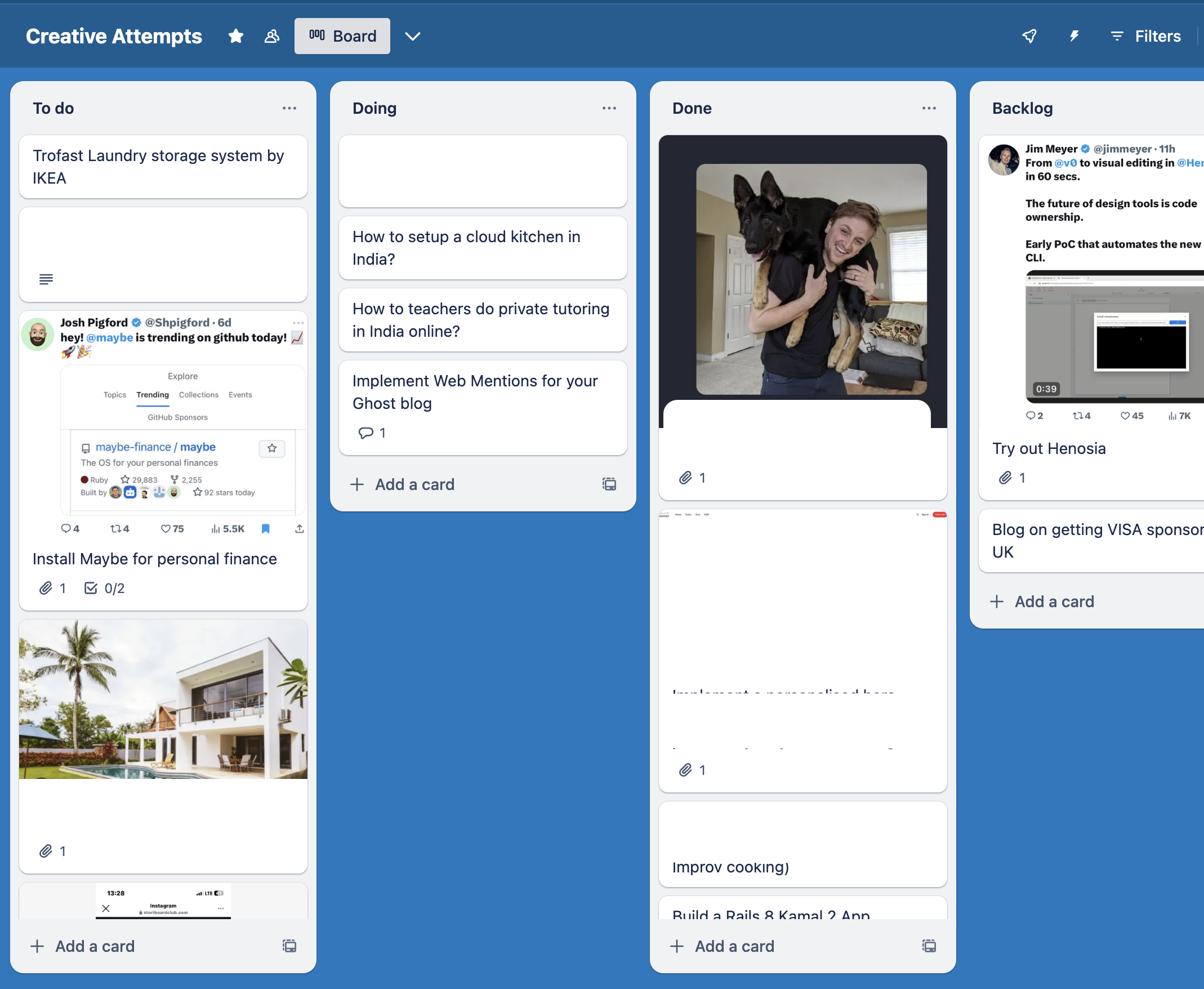
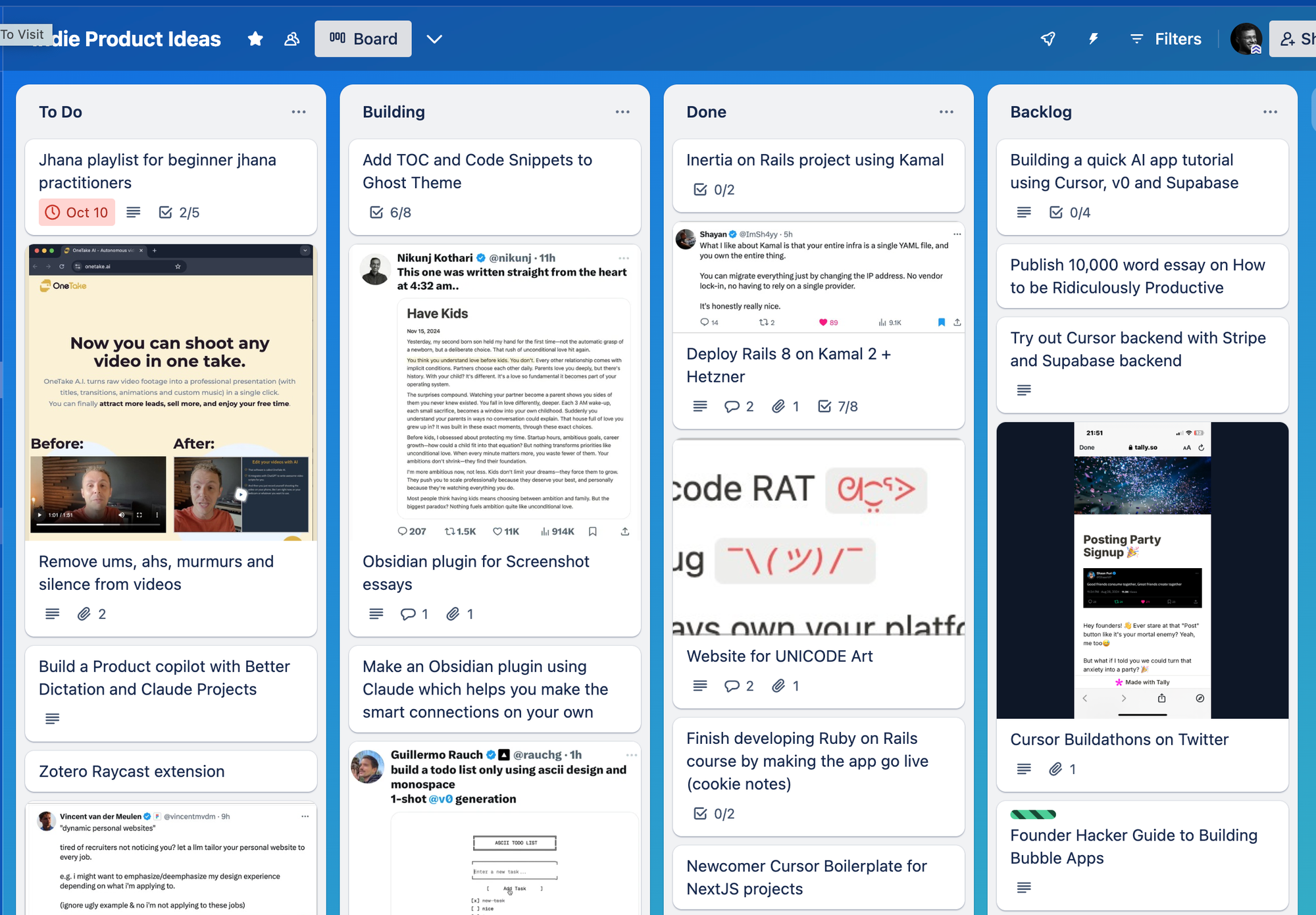
But by purely looking at the number of ‘ideas’ I’ve shipped, or in terms of the number of ideas I have been able to distill, this has been a huge success for me (The kanban board is easy to visualise and measure your throughput).
Even if you had a process to brew ideas, you still needed rich stimuli, great share of experiences around you to filter and distill some of them out. If we take Seneca for example — If we were to write this in a true 4chan anon style:
Seneca was mentored under a controversial tutor named Attalus (who was later exiled) > Got tuberculosis, and spent 10 years in Egypt > Had a terrible shipwreck that killed his uncle > Entered politics in Rome, and was exiled and nearly executed > Banished to spent eight years in a distant island of Corsica > Becomes an investor, and started playing gladiatorial games
Each of his life episodes screams ‘biography material’. If we compare this to all the bland resumes of us, they seem very uninspiring. We need more interesting experiences to then project a unique point of view to the world.
Although I’ve got better at organising my ideas to brew them lazily, I still suck at the ‘art of observing’. And I think that’s not a trivial thing to do, to realise that some aspects of your life could be done way, way better. Let’s take the example of the design of everyday things. Doorknobs. Or even forks. It’s extremely hard to come up with a new design for a fork.
Articulating the problem is half the work. The hardest part is to articulate that there needs to be a better design for a new fork. James Clear articulates this conundrum using the 4 Burner theory.
One way to think about work-life balance is with a concept known as The Four Burners Theory. Here’s how it was first explained to me:Imagine that your life is represented by a stove with four burners on it. Each burner symbolizes one major quadrant of your life.1. The first burner represents your family.2. The second burner is your friends.3. The third burner is your health.4. The fourth burner is your work.The Four Burners Theory says that “in order to be successful you have to cut off one of your burners. And in order to be _really_ successful you have to cut off two.”
This goes with ideas as well. When we start documenting ideas in architecture, we see even more ideas in the same domain. It’s as if an increase in our observation powers in architecture, leads to a diminishing observation power in gardening, or cars for that matter. You could turn ‘architecture aesthetics’ to full heat, but you either bring all three other themes down by a notch, or even turn one totally off.
I would say, just brew your ideas lazily, and choose your ‘burners’ carefully.
Read more
- Home is where the feeling of home residesreflections
- Notes on doing most good, doing some good, and living goodphilanthropy
- Notes on Londontravel
- 18 key ideas from reading Henrik Karlsson this monthwriting
- Venn-diagram based decision makingmathematics
- Co-creative loops are everywheremental-models
- Life lessons and hot takes from my 30slifestyle
- Building a skill for coherent science illustrationsscience
- My agentic engineering workflow (step by step)agentic-coding
- Hammock driven developmentagentic-coding
- Peculiar ways number three fits into our funny little brainsmental-models
- AI sandwich as a defacto principle for anything agentic engineering relatedagentic-coding
- Authority in the guise of evidencecritical-rationalism
- Map is not the territoryphilosophy
- Self hypnosis as a manifestation ritualmeditation
- Hegelian dialectic for structured reasoning with AI agentsphilosophy
- How I prepare for tough negotiations nowadaysnegotiation
- When should we steelthread somethingproduct-development
- Breadboarding, shaping, slicing, and steelthreading solutions with AI agentsproduct
- Healthy conflict in teams have a tipping pointteam-building
- How I deslopify AI writingwriting
- How I started building softwares with AI agents being non technicalagentic-coding
- Read raw transcriptswriting
- Legible and illegible tasks in organisationsproduct
- L2 Fat marker sketchesdesign
- Writing as moats for humanswriting
- Beauty of second degree probesdecision-making
- Boundary objects as the new prototypesprototyping
- One way door decisionsproduct
- Finished softwares should existproduct
- How I periodically rank my rough draftsobsidian
- Flipping questions on its headinterviewing
- Vibe writing maximswriting
- How I blog with Obsidian, Cloudflare, AstroJS, Githubwriting
- How I build greenfield apps with AI-assisted codingagentic-coding
- We have been scammed by the Gaussian distribution clubmathematics
- Classify incentive problems into stag hunts, and prisoners dilemmasgame-theory
- I was wrong about optimal stoppingmathematics
- Thinking like a shipmental-models
- Hyperpersonalised N=1 learningeducation
- New mediums for humans to complement superintelligenceagentic-coding
- Maxims for AI assisted codingagentic-coding
- Virtual bookshelvesaesthetics
- It's computational everythingtrends
- Public gardens, secret routesdigital-garden
- Git way of learning to codeagentic-coding
- Style Transfer in AI writingagentic-coding
- Understanding codebases without using codeagentic-coding
- Vibe coding with Cursoragentic-coding
- Virtuoso Guide for Personal Memory Systemsmemory
- Writing in Future Pastwriting
- Publish Originally, Syndicate Elsewhereblogging
- Poetic License of Designdesign
- Idea in the shower, testing before breakfastsoftware
- Technology and regulation have a dance of ice and firetechnology
- How I ship "stuff"software
- Writing is thinkingwriting
- Song of Shapes, Words and Pathscreativity
- How do we absorb ideas better?knowledge
- Read writers who operatewriting
- Trees, Branches, Twigs and Leaves — Mental Models for Writingwriting
- Compound Interest of Private Noteswriting
- Conceptual Compression for LLMsagentic-coding
- Meta-analysis for contradictory research findingsdigital-health
- Proof of workproduct
- Gauging previous work of new joinees to the teamleadership
- Task management for product managersproduct
- Beauty of Zettelswriting
- Stitching React and Rails togetheragentic-coding
- Exploring "smart connections" for note takingwriting
- Deploying Home Cooked Apps with Railssoftware
- Repetitive Copypromptingwriting
- Questions to ask every decadejournalling
- Balancing work, time and focusproductivity
- Hyperlinks are like cashew nutswriting
- Brand treatments, Design Systems, Vibesdesign
- How to spot human writing on the internetwriting
- Can a thought be an algorithm?product
- Opportunity Harvestingcareers
- Everything is a prioritisation problemproduct
- Nowlifestyle
- How I do product roastsproduct
- The Modern Startup Stacksoftware
- In-person vision transmissionproduct
- How might we help children invent for social good?social-design
- The meeting before the meetingmeetings
- Design that's so bad it's actually gooddesign
- Lessons learnt interview prepping for product rolesinterviewing
- Obsessing over personal websitessoftware
- English is the hot new programming languagesoftware
- Better way to think about conflictsrisk-management
- The role of taste in building productsdesign
- Dear enterprises, we're tired of your subscriptionssoftware
- Products need not be user centereddesign
- World's most ancient public health problemsoftware
- Pluginisation of Modern Softwaredesign
- Let's make every work 'strategic'consulting
- Making Nielsen's heuristics more digestibledesign
- Startups are a fertile ground for risk takingentrepreneurship
- Insights are not just a salad of factsdesign
- Minimum Lovable Productproduct
- Methods are lifejackets not straight jacketsmethodology
- How to arrive at on-brand colours?design
- Minto principle for writing memoswriting
- Importance of Whytask-management
- Quality Ideas Trump Executionsoftware
- Why I prefer indie softwareslifestyle
- Use code only if no code failscode
- Self Marketing
- Personal Observation Techniquesdesign
- Design is a confusing worddesign
- A Primer to Service Design Blueprintsdesign
- Rapid Journey Prototypingdesign
- Visualise detailed file structures on CLIcli
- Do's and Don'ts of User Researchdesign
- Design Manifestodesign
- Complex project management for productproducts
- How might we enable patients and caregivers to overcome preventable health conditions?digital-health
- Pedagogy of the Uncharted — What for, and Where to?education
- Future of Equity with Ludovick Petersinterviewing
- Future of Ageing with Mehdi Yacoubiinterviewing
- Future of Tacit knowledge with Celeste Volpiinterviewing
- Future of Mental Health with Kavya Raointerviewing
- Future of unschooling with Che Vanniinterviewing
- Future of Rural Innovation with Thabiso Blak Mashabainterviewing
- Future of work with Laetitia Vitaudinterviewing
- How might we prevent acquired infections in hospitals?digital-health
- The why to endure any howentrepreneurship
- Design education amidst social tribulationsdesign
- How might we assist deafblind runners to navigate?social-design