How might we enable patients and caregivers to overcome preventable health conditions?

Intended Audience—For product leaders and healthcare professionals working in the intersections of behaviour change, digital health and medical support
For MCH, a study we conducted in 2021 observed strong evidence that the health messaging service (RES) improved maternal knowledge and infant care. It observed significantly higher rates of breastfeeding, safe infwhyant-feeding practices, and skin-to-skin care among the intervention group, as well as greater knowledge of maternal nutrition, breastfeeding, and cord care best practices.
Imagine being a young mother-to-be, living in a remote village in Bangladesh, eagerly awaiting the birth of your child. You make the long journey to the nearest hospital for a routine check-up, filled with excitement.
But as you leave, a sense of uncertainty weighs heavy – how can you ensure you’ll have the knowledge and support to care for your newborn properly?
For millions of marginalised patients and caregivers across Bangladesh, this is a harsh reality. Overstretched public health systems mean many leave healthcare facilities unprepared, risking preventable complications due to a lack of essential care knowledge.
But what if a simple technological solution could bridge that gap? A digital lifeline providing vital health education and support directly to those who need it most?
Over the past 30 months, my team has poured our heart, soul, and countless hours into developing just that – a Remote Engagement Service (RES) using accessible channels like WhatsApp and voice calls. And the impact has been lifesaving.
In this essay, I’ll take you on the journey of Rabeya, that young expectant mother, and share the insights gained from our efforts with RES Bangladesh—
A patient using the Remote Engagement Service (RES) on Whatsapp, listening in to an informative video on how to take better care of her baby
While Rabeya eagerly waits for the doctor’s appointment, she participates in the Care Companion Program, a health education service conducted by the nurses. Through simple language, the nurses provide guidance about the importance of nutrition, routine check-ups and self-care.
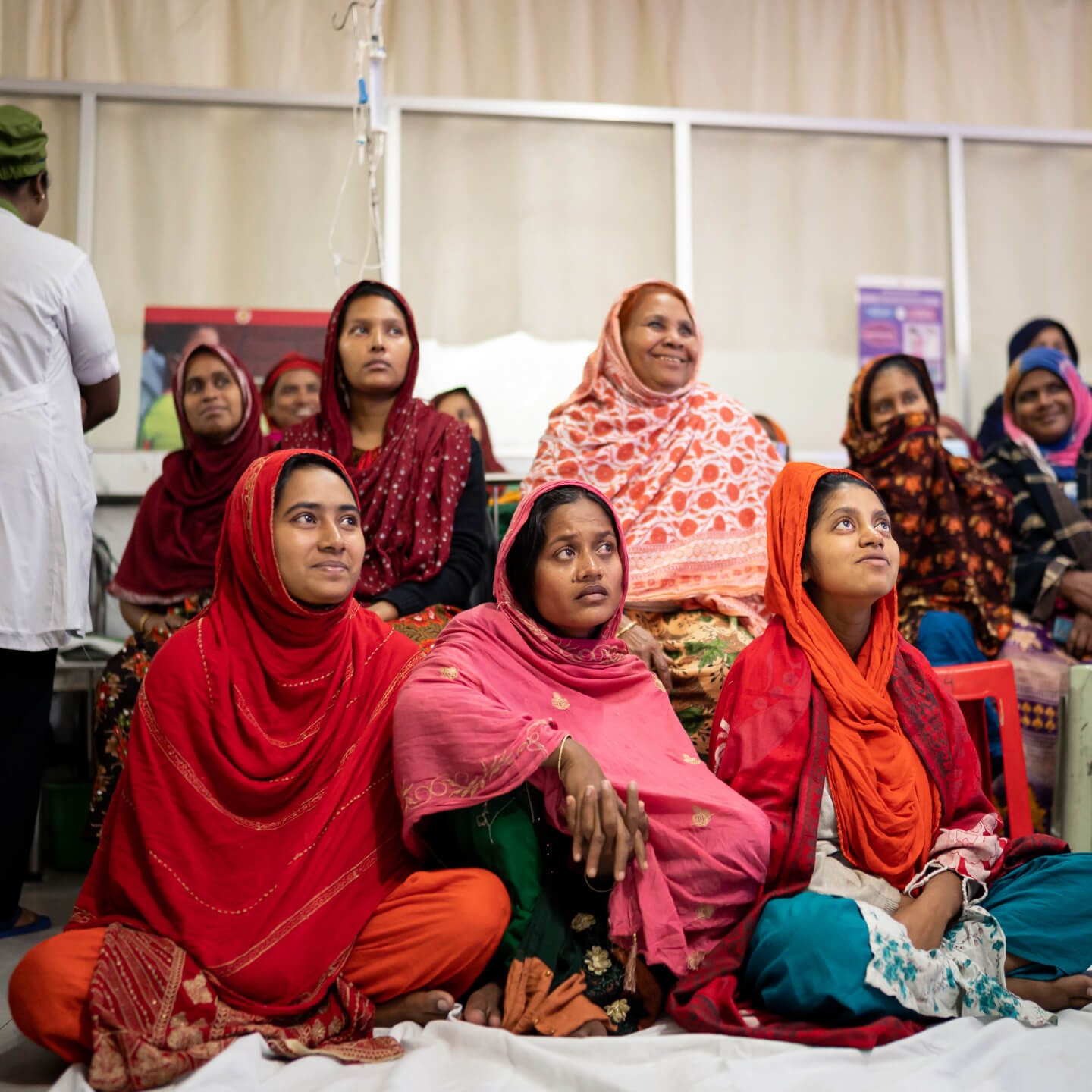
Rabeya is introduced to the RES service for the first time during the health education session conducted within the hospital
At the end of the hospital session, the nurse encourages Rabeya to subscribe to RES either through a QR code, or by directly calling the phone number.

Three step process of onboarding users to the relevant health service
Rabeya is onboarded to the service through a simple three-step process. She selects the campaign for expectant mothers, as well as her preferred medium (in this case, she chooses Whatsapp over a voice call service).

Once onboarded, she is gently nudged to enter her expected due date on Whatsapp. The RES service gets personalised based on this crucial timing.

The content is tailored around the (a) desired health behavior and outcomes from the larger program, (b) specific asks from the government stakeholders, and (c) identified gaps in the patient journey
As an expectant mother, Rabeya is guided towards doing her regular pregnancy checkups from nearby facilities. She is also reminded to take her iron and folic acid tablets on time.
As she starts learning about various key topics, she starts asking questions surrounding her pregnancy. One day, she notices some signs in her body and remembers to seek help from the service.
In this way, she receives health support from clinical experts such as nurses and doctor as and when needed from the comfort of her home.
Rich media is used liberally to reinforce key health topics and to aid in retention
As shown from the journey of Rabeya, these are the core features of RES:
- Availability across multiple modalities: WA (scheduled messages, chatbot, and live chat), Voice (IVRS), Teletraining (live calls)
- Availability across multiple condition areas: MCH (Maternal and Child Health), NCD (Non Communicable Diseases), Cardiovascular, TB (Tuberculosis), General Surgery/Medicine
- Human-in-the-loop AI health responses: Only medical experts provide health responses. By leveraging LLMs, responses are served in a reliable, accurate and efficient manner
- Provides Behavior Change Communications: Both instructional and narrative styles of content, rich media (images, gifs, short-videos)
- Customized to stage and severity of need
Journey behind building RES
I’ll go one level deeper into the process followed—
The product cycle went through various key phases such as Defining Business Outcomes, Discover, Validate, Build, Launch, Evaluate, and Iterate.
Although this process appears neatly structured in hindsight, the reality of product development was more cyclical. As we gathered insights from our users, the problem space and solution space co-evolved, continuously shaping each other in response to new learnings.
Phases
One—Defining Business/Impact Outcomes
The phases such as Defining Business Outcomes, Discovery, Validation, Building, and Launching might seem like disparate blocks, but they were all tied together by the vision. This vision serves as the connecting tissue, helping move the pieces together seamlessly, like a well-oiled engine without any jitters.
As a Business-to-Government-to-Consumer (B2G2C) model, we aimed to support Bangladesh government’s health initiatives were focused on reducing the maternal mortality rate (MMR) and infant mortality rate (IMR). Bangladesh had roughly ~157 maternal deaths per 100,000 live births. To provide a benchmark, the Netherlands has ~4 maternal deaths per 100,000 live births. Noora Health’s pitch to the government was to establish family caregiving as a standard of care, thereby reducing the MMR and IMR rates through the intervention.
Noora Health’s model consists of a cost-sharing model with health systems and funding support from a diversity of sources, including foundations, individuals, partnering organisations, and corporate giving. The cost sharing model allows Noora to eventually step-back from directly overseeing the program, enabling it to become an integrated and sustainable part of the healthcare infrastructure.
We got into our first MoU with the BD Health Ministry to pilot, gain evidence, and to integrate the program into the public health systems. That’s how we started our operation.
My initial efforts during this phase was to make RES simple and easy to remember. To reduce the complexity in the communication, and to revive and evangelise interest towards RES, I showed a vision for RES BD—Every user overcomes any preventable medical condition digitally. Nurses were also trained to communicate RES in a simplified manner as—‘Health education for you and your baby’.
Framing the vision in the format of a ‘future press-release’ to get team/stakeholders excited about the RES vision
Creative Team at Noora Health assisted us in developing powerful visualisations through a storyboard to explain the ease with which one could get onboarded to the RES service
To make the direction of the vision even clearer, I worked closely with the Head of Product to break down the complex roadmap of RES into a simpler, more digestible format for all team members.
We visualised RES as a train engine consisting of multiple blocks. We had the signup engine, an engagement engine, as well as a response engine. For each, we depicted the current state, and the future state to receive inputs from the larger team.
Discovery Phase
Recognising that a direct replication of our previous strategies in India wouldn’t suffice, we approached the situation with a fresh perspective.
My team and I explored the patient health journey across district hospitals, sub-district hospitals, and primary care centers in Bangladesh. This exploration aimed to map out how patients were accessing healthcare systems.
Mapping the current journey of a newly delivered mother
We were not optimising for a single user journey; rather, we addressed multiple journeys across various segments and touchpoints. Consider Rabeya’s path—her experience extended far beyond that initial visit to the sub-district hospital.
Rabeya might attend her antenatal checkups at the local health complex, received home visits from community health workers, and may have even been referred to a higher-level facility for certain procedures or complications.
Each touchpoint represented a crucial opportunity to educate, empower and provide continuous support tailored to her evolving needs.
Documenting the outcomes from the synthesis into various themes such as technology, personnel, health system etc. All these contributed to the drafting of the requirements
This synthesis (through affinity maps) informed the initial draft of our product requirements document, ensuring it was grounded in the diverse findings from our field and desk research. This helped us to imagine the desired journey in contrast to the current journey.

Outlining decisions, the assumptions, and checkpoints on how we were validating the assumptions
Another framework which proved to be quite useful in digesting the complexity of the multi-touchpoint user journey was the service blueprint.
Service blueprint served as a great way to visualise and communicate not just the front stage actors, but the backstage actors, as well as the backend processes required to ensure everything is seamless.
Some key directions from our discovery phase:
Voice calls as a primary medium—During our discovery phase, we analyzed the overall usage of smartphones among the rural populations in Bangladesh. As of last year, 41% of mobile phone users in the country had smartphones. With low WhatsApp penetration and internet usage being distributed among various platforms like Facebook and Emo, Interactive Voice Response (IVR) was chosen as the primary medium for our RES service. This decision was supported by our field observations and corroborated by reports, which indicated that often only one smartphone is available per family in rural areas (The Business Standard) (GSMA).
Timing our service around date of discharge — We designed our RES service to start immediately after a high-risk baby is discharged from the hospital, typically after 7-9 days. This timing aligns with one of our core design principles: to provide the right information at the right time. We adopted a similar strategy of timing our service while designing for diabetes patients, surgical care, newly delivered mothers etc.
Contextualisation and personalisation of the messages — RES campaigns were made more personalised to the geography they served. We adopted a more conversational format mixing curative, and promotive themes for behaviour change. We went on to also hire country specific teams across the Health Communications, Medical Strategy as well as Media/Film to ensure the content was adapted to the context.
A typical SCANU facility in Bangladesh
All these guidelines and features were depicted in the product requirements doc that served as a means of garnering consensus, providing clarity to the respective engineering and design teams.
Validation Phase
Should we build and then test? Or should we test and then build?
When facing this dilemma of whether to—build and then test a product or to test and then build, our approach varied based on the situation. As we always dealt with the trifecta of scope, time and effort, we needed a more structured approach to deal with these decisions. For more ‘risky’ features, we designed a lightweight pilot version first to test the concept in a controlled, manageable way. However, if the associated risks were minimal, we chose to launch first and then validate the feasibility afterwards.
This is an example of a feature which we implemented by testing first before building — For conversational IVR, as this was a high-impact and a crucial part of the onboarding flow, we didn’t want to take any chances and performed a gradual rollout with significant period of testing internally by dogfooding
Build/Launch Phase
Our product development process blended elements of both waterfall and agile methodologies, particularly crucial in the healthcare sector where careful planning of user-facing releases is imperative.
We methodically rolled out features over a 2.5-year timeline, carefully managing the evolution and growth of the service. The roadmap for what needed to be built was articulated in a detailed service map that facilitated collaborative feedback from all stakeholders. This ensured smooth transitions during technical handoffs, reducing risks and enhancing the effectiveness of our launches.
This was a standard format used while we went ahead developing various features as a part of the product roadmap.
Evaluate Phase
Before we evaluated, we didn’t have proper systems to evaluate. When we started, we lacked a centralised product dashboard integrating data from various sources.
12-month long ongoing effort by the Data Engineering Team to streamline data collection efforts, building systems towards data warehousing, establishing pipelines, as well as dashboarding
Setting up systems for data-led evaluations
To support the tech team, I created early prototypes of the dashboard to demonstrate our requirements to the tech team. The visual prototypes proved to be useful for kickstarting conversations around the dashboard and gaining momentum to push it forward.
After diagnosing, and identifying the gaps, the data engineering team established pipelines, warehouses and the dashboard for helping us take data-driven decisions.
Early visualisations of the dashboard used in formulating the tech requirements. This eventually led to a full-fledged dashboard that helped improve the service over time
Setting up systems for user-led feedback loops
To collect more insights from the field and from our users themselves using our service, we established a regular schedule of field visits for the RES team to engage directly with patients and caregivers. This allowed us to continuously gather and analyse data from various channels to better understand their needs.
Key initiatives that I spearheaded to deepen our user-feedback loops included:
Mid-campaign support calls -These calls not only built trust with caregivers but also served as vital two-way communication channels. For instance, we discovered that 96% of our Whatsapp users read our messages, but struggled with literacy, impacting their understanding of the health-related content.
End-campaign surveys and feedback - Responses to our messages and updates from the delivery and implementation teams were crucial in synthesizing insights. On one occasion, we learned that users were sharing the RES contact number using takeaway cards among family members. This observation prompted us to redesign these cards to facilitate easier dissemination among patients and caregivers.
Taking effective decisions — A good decision was a mix of taste, data and insights. After having set up systems to process data, systems for gaining user feedback, it became relatively easier to take crucial decisions. Taking both data and insights into the decision making process was quite crucial. In some cases, we had contradictory user viewpoints. Or in other cases, the data was quite contradictory to the user narrative.
What people say, is different from what people do, is different from what people think.
Example decision—Deciding between voice calls and Whatsapp
In a recent strategic decision about expanding our service, we needed to determine the best communication channel for our users. The options were Whatsapp, Interactive Voice Response (IVR), or a combination of both (IVR+WA). To inform our decision, I analyzed user engagement data from the past quarter, comparing the interactions of IVR+WA users against those using only Whatsapp. Additionally, feedback from telesupport calls to current users provided further insights. This comprehensive analysis led us to adopt Whatsapp as our primary service platform, with an option to switch to IVR for users who became inactive. We found that while 40% of our users connected via Whatsapp, only 40% of those engaged actively responded to our messages.
Example decision—Evaluating telesupport capacity
During the first quarter of 2024, we observed a decline in telesupport productivity, with 28 team members averaging only 2-3 hours of calls per day. To enhance their efficiency without resorting to downsizing, I conducted detailed simulations. These simulations considered their current productivity, total working hours, and potential for additional tasks. Based on this data-driven analysis, we identified four new activities for the telesupport team. Implementing these activities significantly improved their productivity from 20% to 60%.
Iterate Phase
One of my core philosophies in product development is to view each product as a work in progress that is never truly complete. This perspective reinforces the necessity for continuous improvement, as a product is never ‘done’. In managing our development cycles, I advocate for a 70% focus on enhancing existing features (exploit) and 30% on exploring new possibilities (explore). This approach ensures that while we continuously refine our product, we also remain vigilant to emerging cultural, regulatory, economic, and technological trends. Exploration is conducted through a ‘5C lens’—Customers, Collaborators, Competitors, Climate, and Company—to identify and integrate new opportunities into our opportunity hypothesis.
Digital Health Allies: Improved the benchmarking process of researching partner organisations, and scoping out the possible collaborations through an independent platform. I designed this platform to make it easier for the partnerships team to filter out prospects for further reachouts.
For instance, we observed a growing trend in the use of large language models (LLMs) to deliver health-related information quickly and effectively. Inspired by this development, we integrated LLMs into RES, primarily to enhance health intent recognition and support clinicians in providing faster, more accurate responses.
In the exploitation phase—we focused on refining our core product—we devoted considerable efforts to structuring our response system more efficiently. This involved creating knowledge banks to prevent repetitive responses and formalising protocols through standard operating procedures.
To reduce the waiting time for patients, as well as to efficiently use the time of doctors and experts, a ticketing system was setup on Freshdesk were queries were labelled, and organised to avoid answering repetitive questions.
To bring more structure in the type of responses provided, as well as ensure that all responses are coherent in terms of tone, voice etc, standard operating procedures were drafted
Incorporating Feedback—Aligning stakeholders along the whole process was the most challenging part of this process. To solicit timely and relevant input from stakeholders, it was crucial to present them with the appropriate artefacts at the right level of fidelity. Overly detailed artefacts might deter critical feedback, while overly vague ones might not provide enough substance for meaningful commentary. We used one pagers, concept notes, mockups, and sometimes even service prototypes to gather feedback
Beyond simple concept notes, we often found it more effective to simulate the entire user journey through a walkthrough. This approach transformed the experience into an interactive role-play rather than just a static document, making the feedback process more engaging and insightful.
One Pagers — Sometimes showing a prototype might feel like too much effort was put into its production that some stakeholders might avoid providing harsher feedback. They might feel that it’s already well formed, and any critical comments would probably not be incorporated. To avoid this barrier, concept notes/one-pagers come in handy.
One pager for the introduction of conversational IVR feature
Medium Fidelity Prototypes — When I usually build the case around the opportunity, and have to start from zero, momentum is gained with a medium-fidelity prototype. By putting an idea out there, even if it’s totally wrong is much better catalyst for getting to a good solution as people are more likely to react to an idea than to nothing. Prototypes were a great source of enquiry. Prototyping was also my super-power and used my personal conviction to fuel the development of such prototypes.
While setting up RES campaigns, we also observed the inefficiencies in the campaign setup process. Multiple team members logged entries on content spread across multiple spreadsheets which passed through various version edits. To streamline this process, we developed a medium-fidelity prototype of what we envisioned to get the larger team onboard. Noora CMS has automated various manual workflows improving the efficiency of the RES tech-ops team by 40% for campaign development
Imagine Rabeya’s relief at receiving bite-sized WhatsApp lessons perfectly tailored to her needs as a new parent. Or the reassurance of having a supportive voice just a call away, ready to guide her through those inevitable anxious moments. For her, RES Bangladesh became a trustworthy companion on one of life’s most profound journeys.
But the true measure of our success lies not in metrics, but in the countless lives touched.
In parents empowered with knowledge.
In preventable complications avoided.
In the smiles of healthy children born into a brighter future.
Read more
- Home is where the feeling of home residesreflections
- Notes on doing most good, doing some good, and living goodphilanthropy
- Notes on Londontravel
- 18 key ideas from reading Henrik Karlsson this monthwriting
- Venn-diagram based decision makingmathematics
- Co-creative loops are everywheremental-models
- Life lessons and hot takes from my 30slifestyle
- Building a skill for coherent science illustrationsscience
- My agentic engineering workflow (step by step)agentic-coding
- Hammock driven developmentagentic-coding
- Peculiar ways number three fits into our funny little brainsmental-models
- AI sandwich as a defacto principle for anything agentic engineering relatedagentic-coding
- Authority in the guise of evidencecritical-rationalism
- Map is not the territoryphilosophy
- Self hypnosis as a manifestation ritualmeditation
- Hegelian dialectic for structured reasoning with AI agentsphilosophy
- How I prepare for tough negotiations nowadaysnegotiation
- When should we steelthread somethingproduct-development
- Breadboarding, shaping, slicing, and steelthreading solutions with AI agentsproduct
- Healthy conflict in teams have a tipping pointteam-building
- How I deslopify AI writingwriting
- How I started building softwares with AI agents being non technicalagentic-coding
- Read raw transcriptswriting
- Legible and illegible tasks in organisationsproduct
- L2 Fat marker sketchesdesign
- Writing as moats for humanswriting
- Beauty of second degree probesdecision-making
- Boundary objects as the new prototypesprototyping
- One way door decisionsproduct
- Finished softwares should existproduct
- How I periodically rank my rough draftsobsidian
- Flipping questions on its headinterviewing
- Vibe writing maximswriting
- How I blog with Obsidian, Cloudflare, AstroJS, Githubwriting
- How I build greenfield apps with AI-assisted codingagentic-coding
- We have been scammed by the Gaussian distribution clubmathematics
- Classify incentive problems into stag hunts, and prisoners dilemmasgame-theory
- I was wrong about optimal stoppingmathematics
- Thinking like a shipmental-models
- Hyperpersonalised N=1 learningeducation
- New mediums for humans to complement superintelligenceagentic-coding
- Maxims for AI assisted codingagentic-coding
- Virtual bookshelvesaesthetics
- It's computational everythingtrends
- Public gardens, secret routesdigital-garden
- Git way of learning to codeagentic-coding
- Style Transfer in AI writingagentic-coding
- Understanding codebases without using codeagentic-coding
- Vibe coding with Cursoragentic-coding
- Virtuoso Guide for Personal Memory Systemsmemory
- Writing in Future Pastwriting
- Publish Originally, Syndicate Elsewhereblogging
- Poetic License of Designdesign
- Idea in the shower, testing before breakfastsoftware
- Technology and regulation have a dance of ice and firetechnology
- How I ship "stuff"software
- Writing is thinkingwriting
- Song of Shapes, Words and Pathscreativity
- How do we absorb ideas better?knowledge
- Read writers who operatewriting
- Brew your ideas lazilyideas
- Trees, Branches, Twigs and Leaves — Mental Models for Writingwriting
- Compound Interest of Private Noteswriting
- Conceptual Compression for LLMsagentic-coding
- Meta-analysis for contradictory research findingsdigital-health
- Proof of workproduct
- Gauging previous work of new joinees to the teamleadership
- Task management for product managersproduct
- Beauty of Zettelswriting
- Stitching React and Rails togetheragentic-coding
- Exploring "smart connections" for note takingwriting
- Deploying Home Cooked Apps with Railssoftware
- Repetitive Copypromptingwriting
- Questions to ask every decadejournalling
- Balancing work, time and focusproductivity
- Hyperlinks are like cashew nutswriting
- Brand treatments, Design Systems, Vibesdesign
- How to spot human writing on the internetwriting
- Can a thought be an algorithm?product
- Opportunity Harvestingcareers
- Everything is a prioritisation problemproduct
- Nowlifestyle
- How I do product roastsproduct
- The Modern Startup Stacksoftware
- In-person vision transmissionproduct
- How might we help children invent for social good?social-design
- The meeting before the meetingmeetings
- Design that's so bad it's actually gooddesign
- Lessons learnt interview prepping for product rolesinterviewing
- Obsessing over personal websitessoftware
- English is the hot new programming languagesoftware
- Better way to think about conflictsrisk-management
- The role of taste in building productsdesign
- Dear enterprises, we're tired of your subscriptionssoftware
- Products need not be user centereddesign
- World's most ancient public health problemsoftware
- Pluginisation of Modern Softwaredesign
- Let's make every work 'strategic'consulting
- Making Nielsen's heuristics more digestibledesign
- Startups are a fertile ground for risk takingentrepreneurship
- Insights are not just a salad of factsdesign
- Minimum Lovable Productproduct
- Methods are lifejackets not straight jacketsmethodology
- How to arrive at on-brand colours?design
- Minto principle for writing memoswriting
- Importance of Whytask-management
- Quality Ideas Trump Executionsoftware
- Why I prefer indie softwareslifestyle
- Use code only if no code failscode
- Self Marketing
- Personal Observation Techniquesdesign
- Design is a confusing worddesign
- A Primer to Service Design Blueprintsdesign
- Rapid Journey Prototypingdesign
- Visualise detailed file structures on CLIcli
- Do's and Don'ts of User Researchdesign
- Design Manifestodesign
- Complex project management for productproducts
- Pedagogy of the Uncharted — What for, and Where to?education
- Future of Equity with Ludovick Petersinterviewing
- Future of Ageing with Mehdi Yacoubiinterviewing
- Future of Tacit knowledge with Celeste Volpiinterviewing
- Future of Mental Health with Kavya Raointerviewing
- Future of unschooling with Che Vanniinterviewing
- Future of Rural Innovation with Thabiso Blak Mashabainterviewing
- Future of work with Laetitia Vitaudinterviewing
- How might we prevent acquired infections in hospitals?digital-health
- The why to endure any howentrepreneurship
- Design education amidst social tribulationsdesign
- How might we assist deafblind runners to navigate?social-design