How does AI affect UI?

Intended Audience — For conversational UI designers in healthcare industry curious about various UI affordances/design patterns in vogue right now
Our online conversations have been increasingly life-like, but yet life-less at the same time. The UI of apps have become more conversational and chat-like in nature. Not just apps, even websites have their own chat-like interfaces on the side. And all of them face the peril of being infested by bot-like avatars.
As Maggie Appleton points this out, we have more keyword-stuffing “content creators”, and more algorithmically manipulated junk.
It's like a dark forest that seems eerily devoid of human life – all the living creatures are hidden beneath the ground or up in trees. If they reveal themselves, they risk being attacked by automated predators.Humans who want to engage in informal, unoptimised, personal interactions have to hide in closed spaces like invite-only Slack channels, Discord groups, email newsletters, small-scale blogs, and digital gardens. Or make themselves illegible and algorithmically incoherent in public venues.
Bots are not necessary bad or evil, per se. It’s just that the conversations enacted by them often feel soulless. Now, there have been instances where chatbot conversations have been more and more life-like.
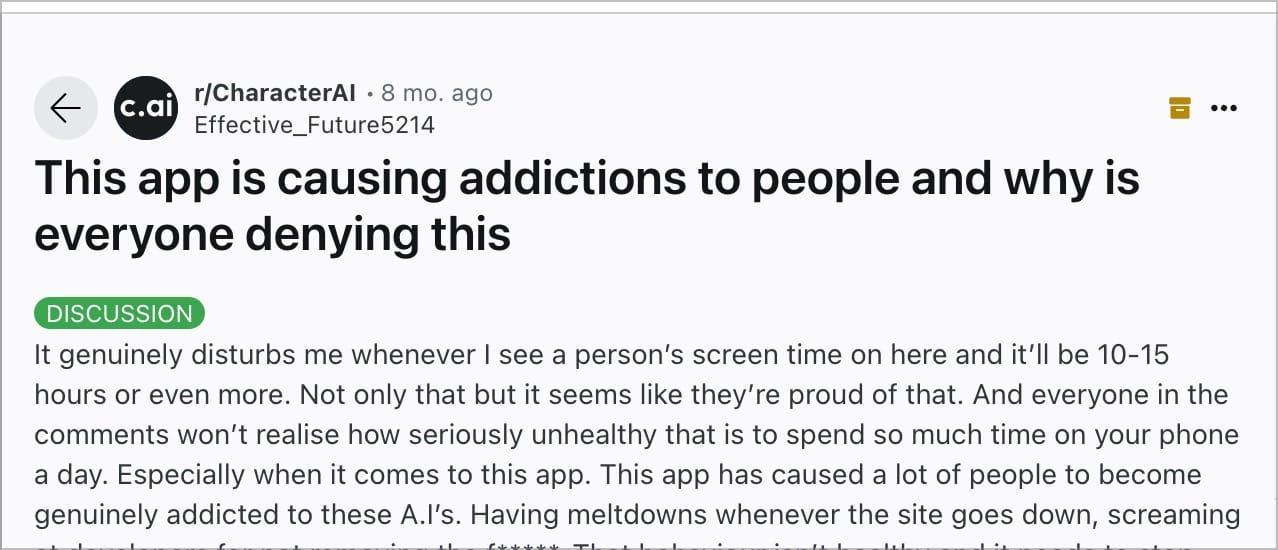
Character-AI, an AI virtual chatbot service has had several reports of users getting addicted to the virtual bots, even choosing to engage with them over their partners
In this environment, it’s interesting to see the design patterns adopted by the industry as we continue to use AI for conversations. Here are some design patterns that have caught my attention:
Offering preset texts
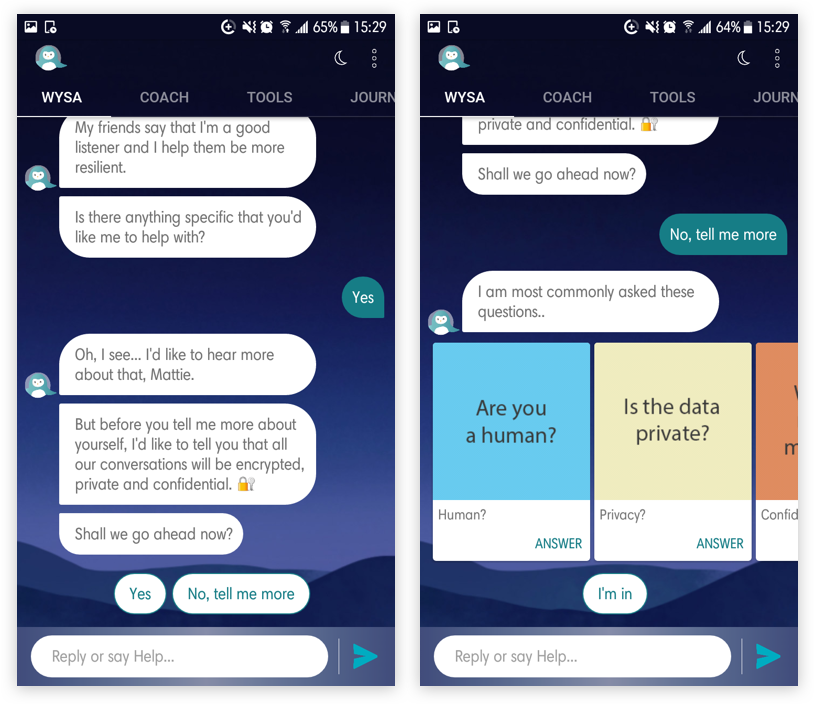
Screenshots from Wysa
The app offers pre-populated short answer suggestions, and suggested options for larger, more informational outputs with minimum user input required. Offering such pre-set text helps direct conversations and limit chances of breaking the conversational flow.
Overcoming gender-bias in voice agents
There is a disproportionate use of feminine names and voices when it comes to voice assistants.
Over the last decade or so, the creators of popular AI voice assistants like Siri, Alexa and Google Assistant have come under fire for their disproportionate use of feminine names and voices, and the harmful gender stereotypes this decision perpetuates. Smart devices with feminine voices have been shown to reinforce commonly held gender biases that women are subservient and tolerant of poor treatment, and can be fertile ground for unchecked verbal abuse and sexual harassment.
Recently came across the Genderless voice initiative, that aims to reduce this gender disparity.
Q is a genderless voice assistant which is able to generate voice which is gender neutral. It would not only reflect diversity of our world, but also reduce the gender bias.
Q, Genderless Voice Assistant
Pre-answer, Post-answer
While chatbots continue to answer questions, it’s important to think about the entire journey of a question. What happens before a question is answered? What happens after a question is answered?
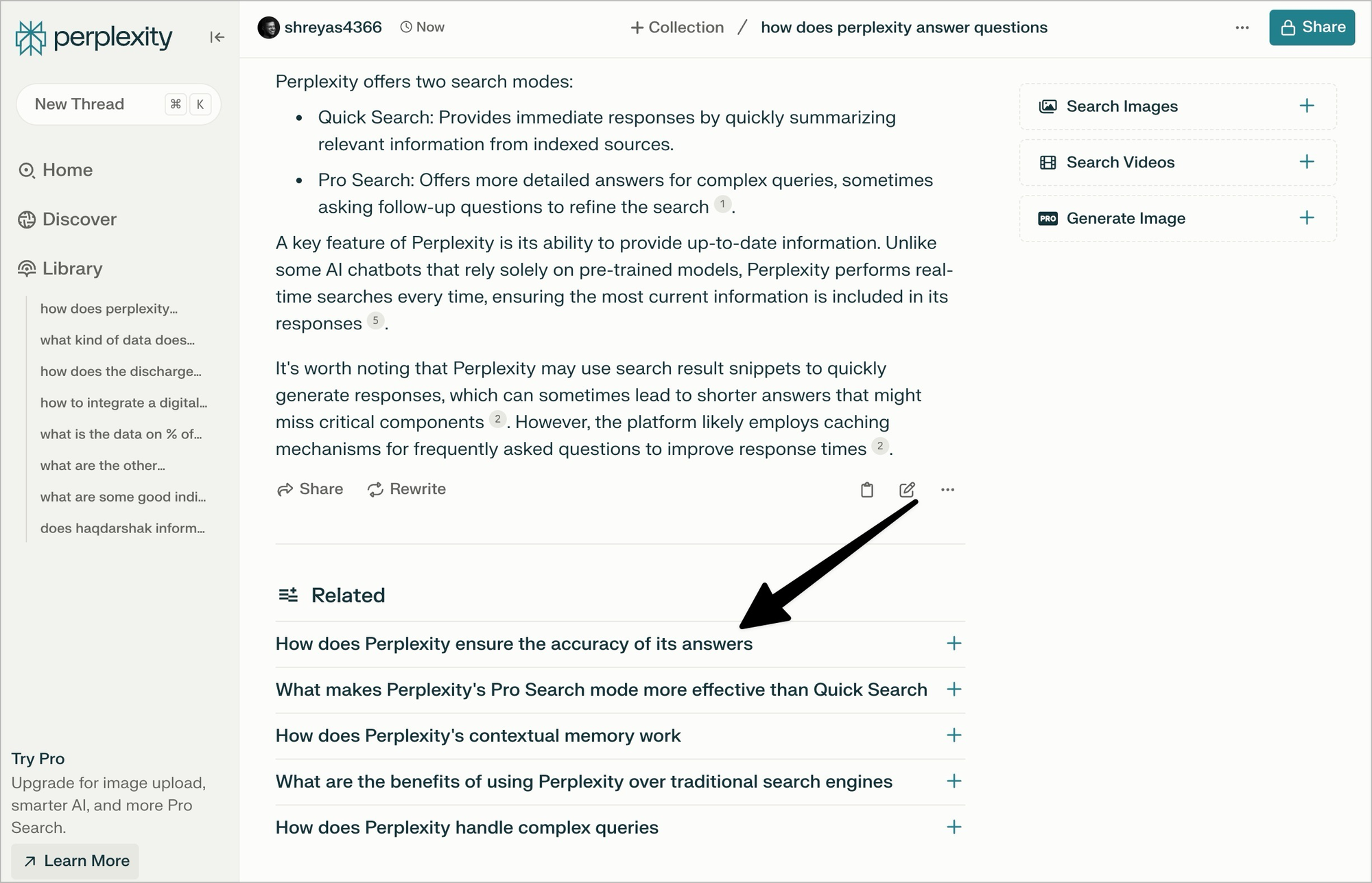
In the above example, Perplexity AI continues to provide cues for digging deeper into the rabbit hole, by providing suggested questions which the user can ask after having answered the question. This helps create a flywheel effect for the user curious about exploring a topic.
Handoff human
When AI related conversational threads don’t go in the expected direction, and if it crosses a certain threshold of steering, the AI directs the conversation to a human expert to take it forward.
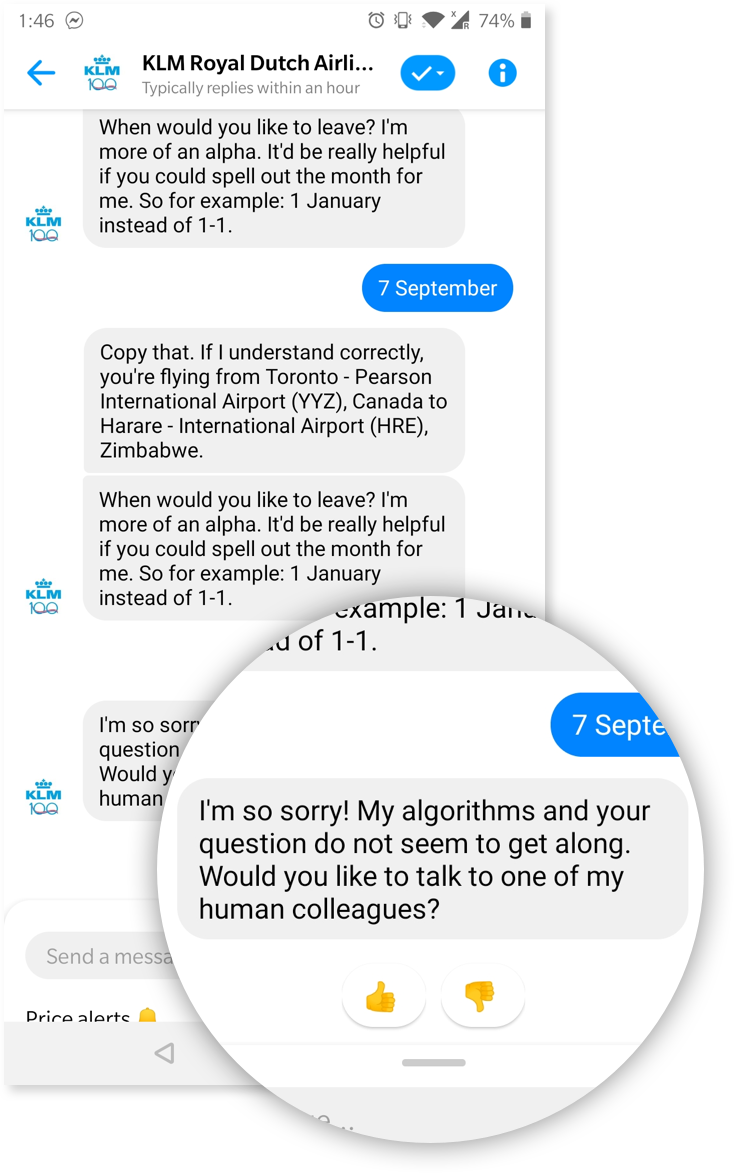
Screenshot from KLM app
In this case, the airline chatbot (KLM) allows the user to switch to direct human interaction when it is unable to complete the task as requested.
Obviously prioritising a hand-off to human agents reduces the efficiencies that automation brings to business processes. But there will always be categories of complex issues that fall outside of an AI’s capabilities, which human agents are better able to solve. Beyond complexity, where a relationship requires empathy, passion, emotion, or another form of authentic human connection, simulating this via AI is still a greater challenge than simply employing human agents to make that connection with the user.
Reducing the thickness of the ‘technical wall’
In healthcare chatbots, most of the answers are quite dense. They might sound as if they’ve been extracted from the first paragraph of a relevant wikipedia article.
Conversational AI agents are trying their best to speak as a friend, and not use dense prose.
The first generation of conversational AI agents were trained in la langue, and not la parole. We see more instances of these agents using the colloquial common tongue, and making themselves sound more human.
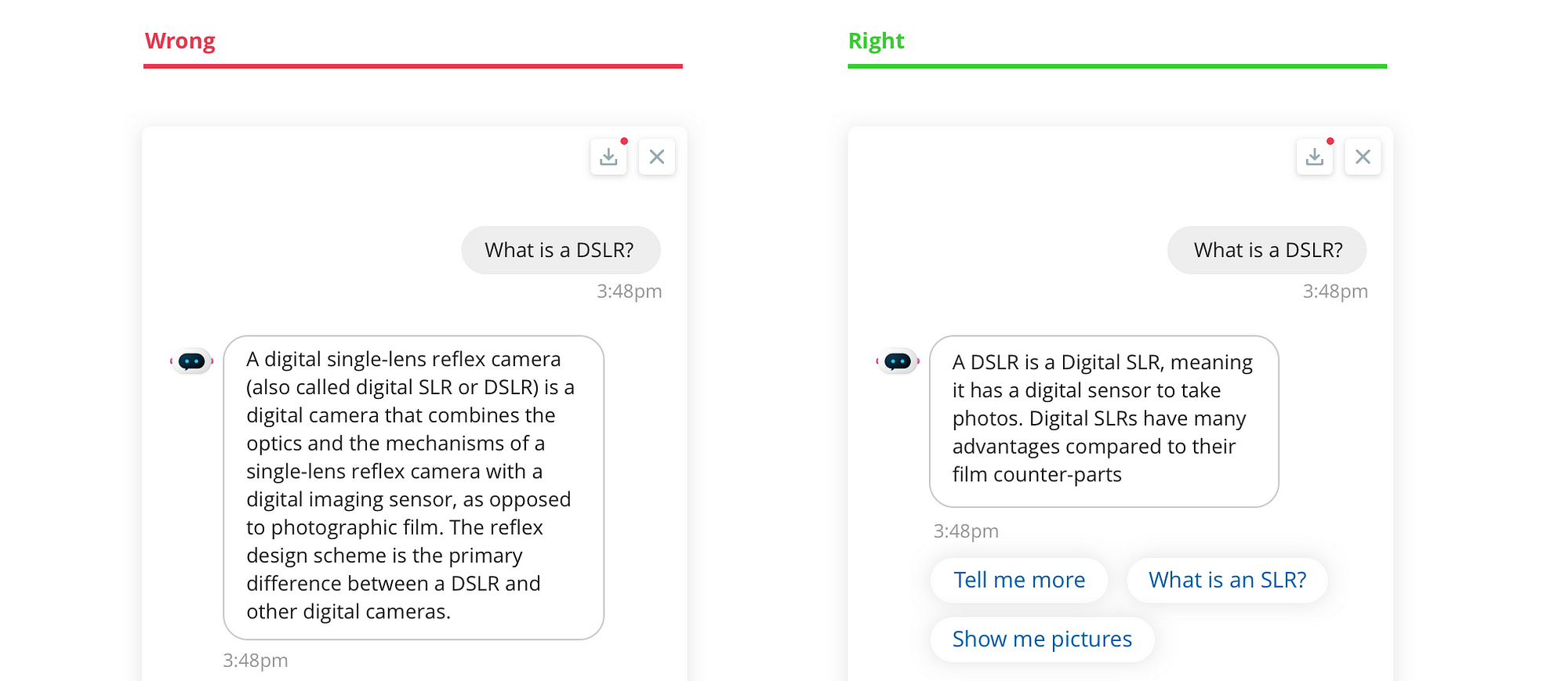
A friend helps you by telling you what they understand by it. This is the language used by AI for helping humans understand and comprehend better
Sidetracks and maintracks
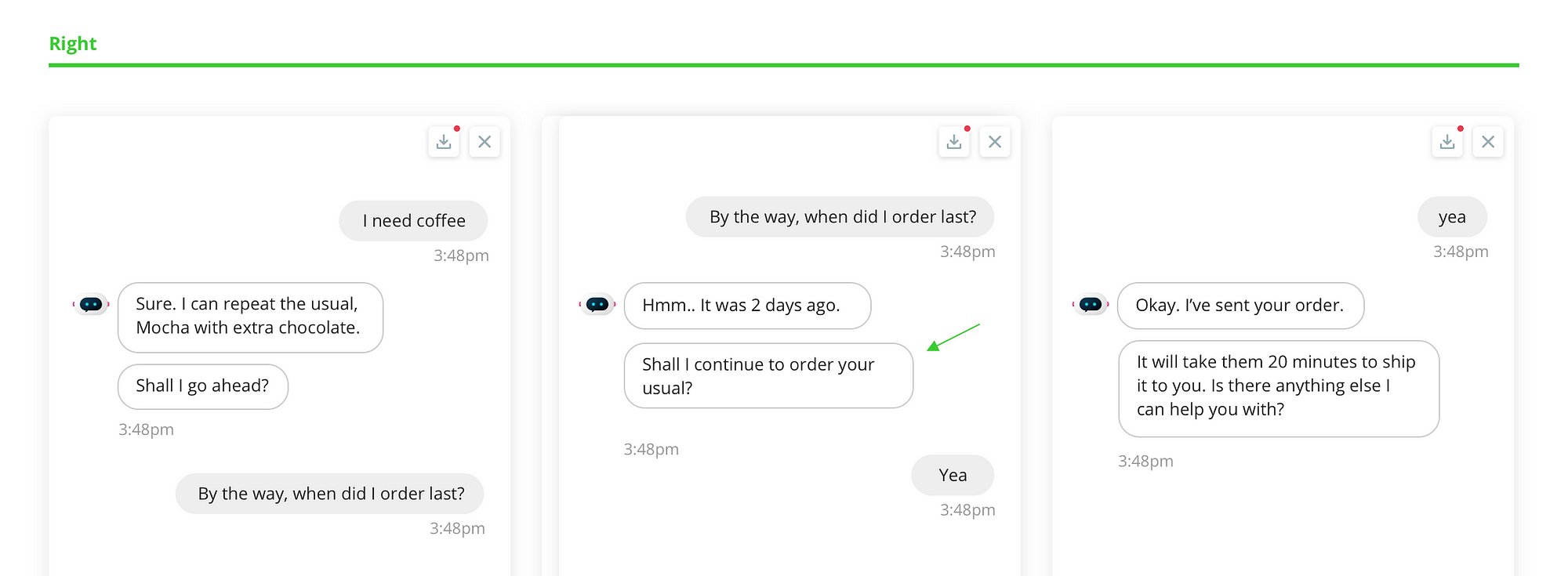
Chatbots usually have an objective. Whenever users slightly get off-track or derailed, it’s important to get them back into the core ‘job-to-be-done’. Why did they come here for? What purpose does this chatbot solve? In the above example, you can see how the agent brings them back to the key function when the user asks multiple topics on different threads.
Avoiding dead ends
It’s important to also design keeping continuity in mind. When we ask the chatbot a question which it doesn’t have an answer to, and it replies with an ‘I don’t know…’. It just ends there in an awkward manner, and there is higher friction to restart the conversation again.
Most people will just give up when chatbots or assistants say something similar to “I’m sorry, I’m still learning”, “I’m not sure I can help with that”.
It is in these situations that the user and the business need the conversation to keep going. Here’s how you do it.
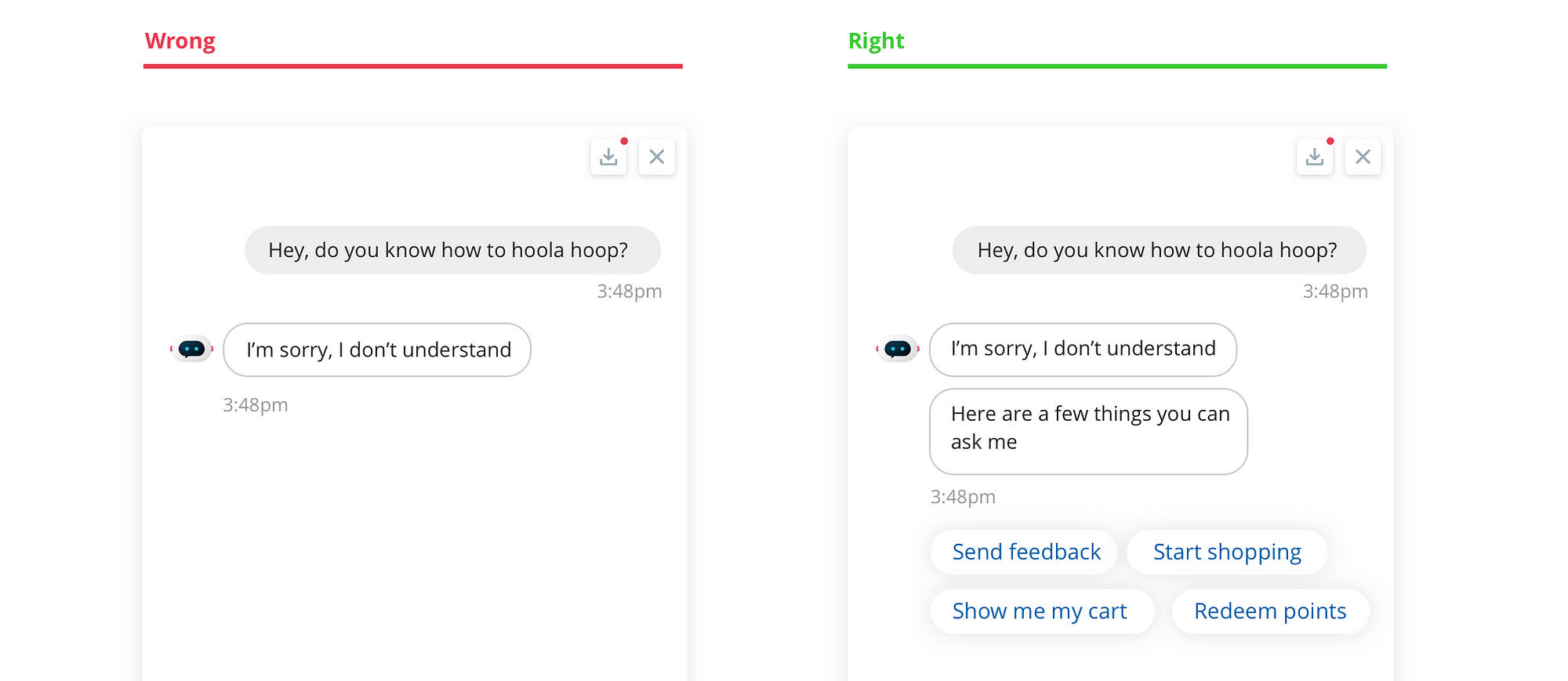
As you can see here, the conversation extends despite the chatbot not having an answer to the user’s immediate question. More starter text is provided to overcome the friction.
Conversational implicature
When users ask a question, what is said, and what is implied might be two different things. It’s important for the chatbot to get the complete context before answering such questions.
If we have a medical topic being shared, and there is an immediate question asked, then the ai should pull in both the previous answer as well as the question to understand the implied question (hidden between the lines)
It is common knowledge that we humans don’t always mean what we say, or say what we mean. We use metaphors or form sentences in the context of other events. For another human being, it’s a natural thing to process this sort of conversations. Of course we “know” what the other person wants. We don’t need people to use a specific set of words.
This is called as conversational implicature.
We see this a lot in customer service. Customers who call about a broken internet connection complain about the same problem in a different way. “I’m not able to get online” and, “I think my internet is broken” is both indicative of “a problem” and the problem is “lack of internet”. This is why you need to write alternate queries for the same piece of information.
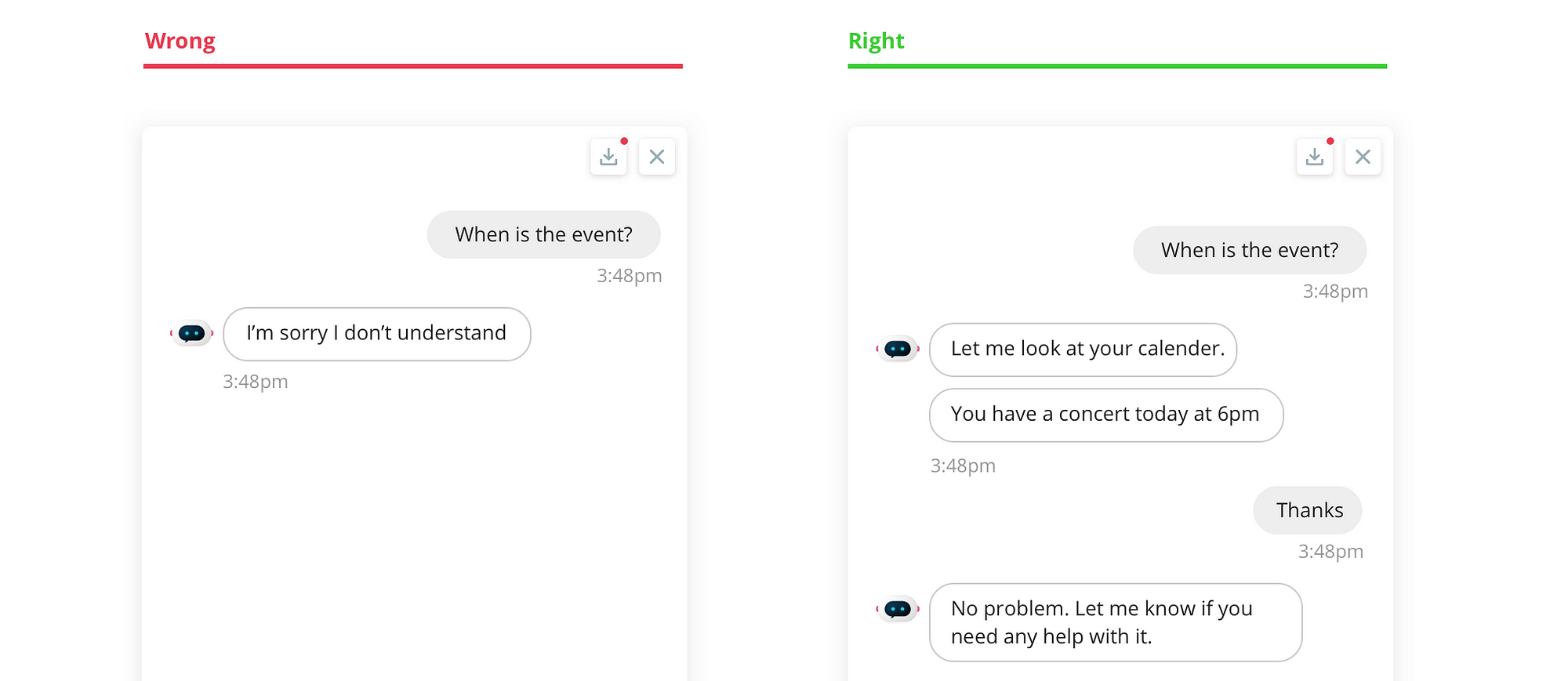
Thinking about what they mean, why they said it and what they actually said can help you give a holistic user experience.
Citations for trust
Citations help users verify that the referenced material is relevant and valid. This way users don’t cede control over the accuracy of their content to the AI’s search engine.
The adoption of RAG (Retrieval Augmented Generation) has helped dramatically improve the AI’s response by getting really good at the needle-in-the-haystack problem.
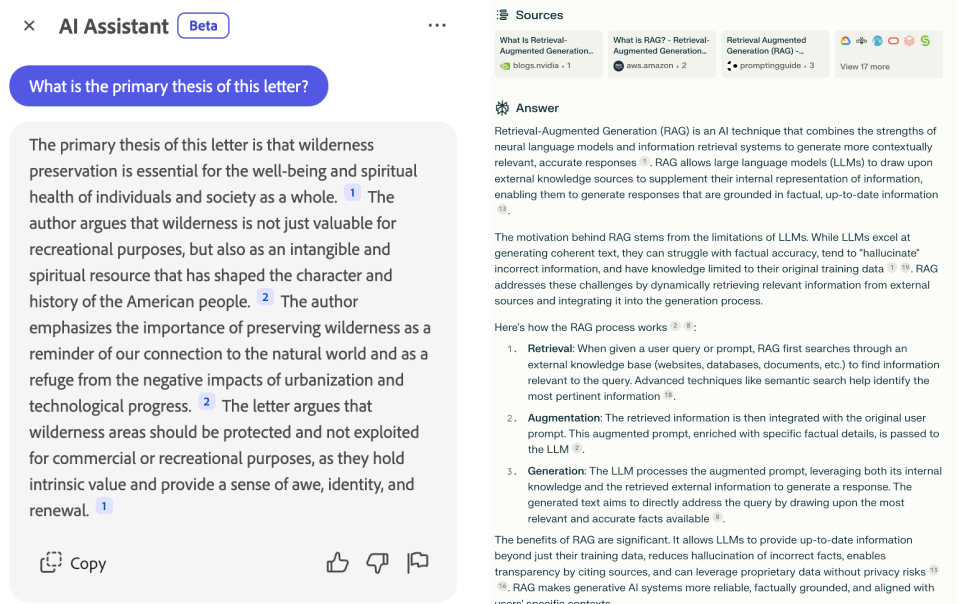
Now, instead of simply summarizing a topic or a primary source, AI can collect information from multiple sources and aggregate it into a single response. Citations help users trace the information contained in a response back to its original material.
And there is more to the list!
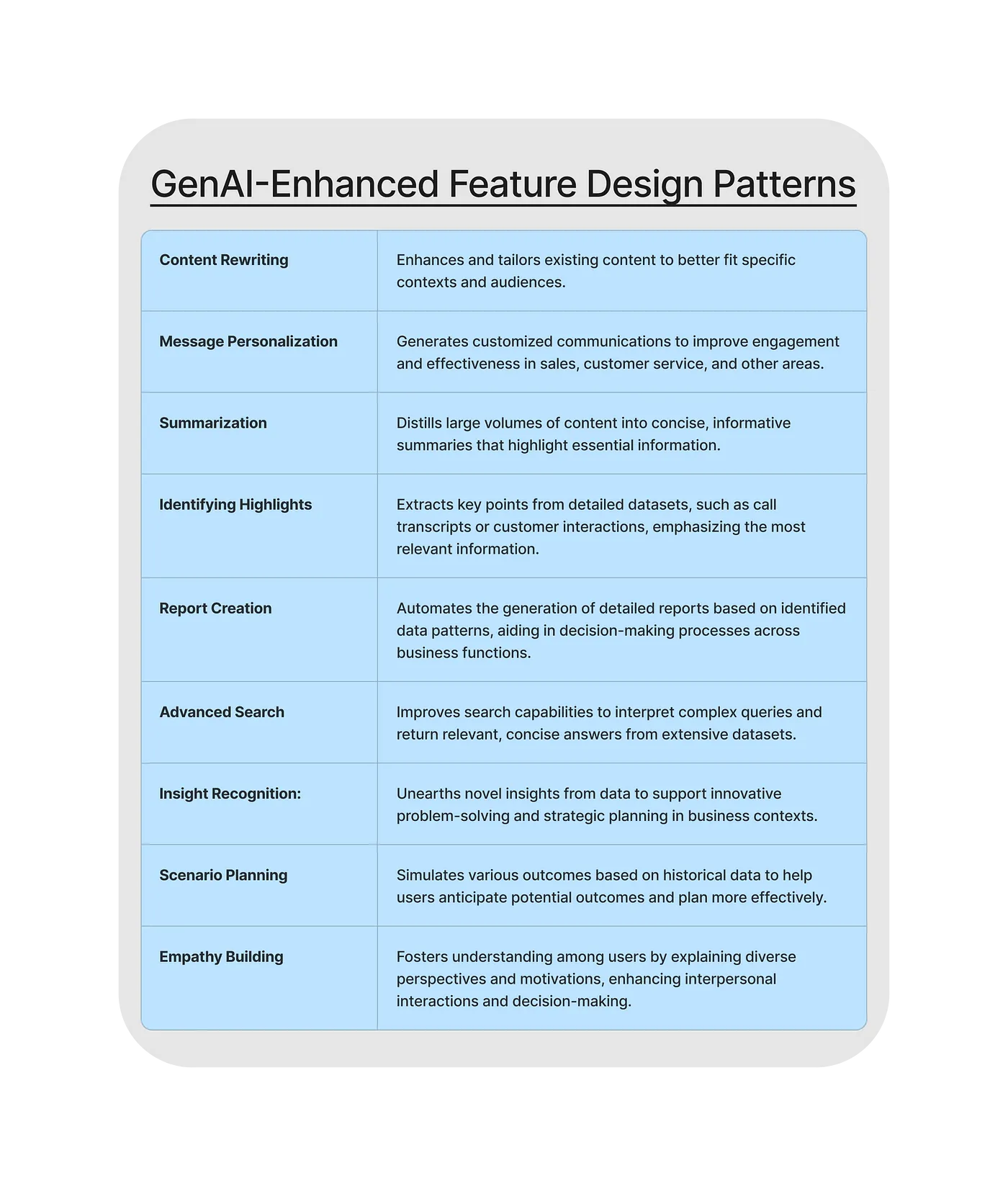
Table of the nine GenAI-Enhanced Design Patterns
These are the nine broad design patterns that have proliferated in the AI landscape over the past year.
Subscribe to get future posts via email (or grab the RSS feed). 2-3 ideas every month across design and tech
Read more
- Hammock driven developmentagentic-coding
- Peculiar ways number three fits into our funny little brains
- AI sandwich as a defacto principle for anything agentic engineering relatedagentic-coding
- How I write essays in 2026writing
- Authority in the guise of evidencecritical-rationalism
- Map is not the territoryphilosophy
- Self hypnosis as a manifestation ritualmeditation
- Hegelian dialectic for structured reasoning with AI agentsphilosophy
- How I prepare for tough negotiations nowadaysnegotiation
- When should we steelthread somethingproduct-development
- How to become a polyglot
- Breadboarding, shaping, slicing, and steelthreading solutions with AI agentsproduct-management
- Healthy conflict in teams have a tipping point
- Deslopify AI writing
- How I started building softwares with AI agents being non technicalagentic-coding
- Read raw transcriptsknowledge
- Legible and illegible tasks in organisationsproduct
- L2 Fat marker sketchesdesign
- Writing as moats for humanswriting
- Beauty of second degree probesdecision-making
- Boundary objects as the new prototypesprototyping
- One way door decisionsproduct
- Finished softwares should existproduct
- How I periodically rank my rough draftsobsidian
- Flipping questions on its headinterviewing
- Vibe writing maximswriting
- How I blog with Obsidian, Cloudflare, AstroJS, Githubwriting
- How I build greenfield apps with AI-assisted codingai-coding
- We have been scammed by the Gaussian distribution clubmathematics
- Classify incentive problems into stag hunts, and prisoners dilemmasgame-theory
- I was wrong about optimal stoppingmathematics
- Thinking like a ship
- Hyperpersonalised N=1 learningeducation
- New mediums for humans to complement superintelligenceai-coding
- Maxims for AI assisted codingai-coding
- Personal Website Starter Kitai-coding
- Virtual bookshelvesaesthetics
- It's computational everythingtrends
- Public gardens, secret routesdigital-garden
- Git way of learning to codeai-coding
- Kaomoji generatorsoftware
- Copy, Paste and Citeai-coding
- Style Transfer in AI writingai-coding
- Understanding codebases without using codeai-coding
- Vibe coding with Cursorai-coding
- Virtuoso Guide for Personal Memory Systemsmemory
- Writing in Future Pastwriting
- Publish Originally, Syndicate Elsewhereblogging
- Poetic License of Designdesign
- Idea in the shower, testing before breakfastsoftware
- Technology and regulation have a dance of ice and firetechnology
- How I ship "stuff"software
- Writing is thinkingwriting
- Song of Shapes, Words and Pathscreativity
- How do we absorb ideas better?knowledge
- Read writers who operatewriting
- Brew your ideas lazilyideas
- Trees, Branches, Twigs and Leaves — Mental Models for Writingwriting
- Compound Interest of Private Notesknowledge
- Conceptual Compression for LLMsai-coding
- Meta-analysis for contradictory research findingsdigital-health
- Proof of workproduct
- Gauging previous work of new joinees to the teamleadership
- Task management for product managersproduct
- Beauty of Zettelswriting
- Stitching React and Rails togetherai-coding
- Exploring "smart connections" for note takingknowledge
- Deploying Home Cooked Apps with Railssoftware
- Repetitive Copypromptingwriting
- Questions to ask every decadejournalling
- Balancing work, time and focusproductivity
- Hyperlinks are like cashew nutswriting
- Brand treatments, Design Systems, Vibesdesign
- How to spot human writing on the internetwriting
- Can a thought be an algorithm?product
- Opportunity Harvestingcareers
- How does AI affect UI?design
- Everything is a prioritisation problemproduct-management
- Nowlifestyle
- How I do product roastsproduct
- The Modern Startup Stacksoftware
- In-person vision transmissionproduct
- How might we help children invent for social good?social-design
- The meeting before the meetingmeetings
- Design that's so bad it's actually gooddesign
- Lessons learnt interview prepping for product rolesinterviewing
- Obsessing over personal websitessoftware
- English is the hot new programming languagesoftware
- Better way to think about conflictsconflict-management
- The role of taste in building productsdesign
- Dear enterprises, we're tired of your subscriptionssoftware
- Products need not be user centereddesign
- World's most ancient public health problemsoftware
- Pluginisation of Modern Softwaredesign
- Let's make every work 'strategic'consulting
- Making Nielsen's heuristics more digestibledesign
- Startups are a fertile ground for risk takingentrepreneurship
- Insights are not just a salad of factsdesign
- Minimum Lovable Productproduct
- Methods are lifejackets not straight jacketsmethodology
- How to arrive at on-brand colours?design
- Minto principle for writing memoswriting
- Importance of Whytask-management
- Quality Ideas Trump Executionsoftware
- How to hire a personal doctor
- Why I prefer indie softwareslifestyle
- Use code only if no code failscode
- Self Marketing
- Personal Observation Techniquesdesign
- Design is a confusing worddesign
- A Primer to Service Design Blueprintsdesign
- Rapid Journey Prototypingdesign
- Visualise detailed file structures on CLIcli
- Do's and Don'ts of User Researchdesign
- Design Manifestodesign
- Complex project management for productproducts
- How might we enable patients and caregivers to overcome preventable health conditions?digital-health
- Pedagogy of the Uncharted — What for, and Where to?education
- Future of Ageing with Mehdi Yacoubiinterviewing
- Future of Tacit knowledge with Celeste Volpiinterviewing
- Future of Rural Innovation with Thabiso Blak Mashabainterviewing
- Future of Equity with Ludovick Petersinterviewing
- Future of work with Laetitia Vitaudinterviewing
- Future of Mental Health with Kavya Raointerviewing
- Future of unschooling with Che Vanniinterviewing
- How might we prevent acquired infections in hospitals?digital-health
- The why to endure any howentrepreneurship
- Design education amidst social tribulationsdesign
- How might we assist deafblind runners to navigate?social-design