Hegelian dialectic for structured reasoning with AI agents

You have an interesting thought in your head, and you want to get it out there, open, out in the internet. It’s spiky, and has all the right characteristics for titillating the audience, hoping to convince the reader of an opinion. When you’re in the heat of the moment, and having this word-burst moment, you ask yourself to think twice before you hit publish, and now that you think about, it does feel like the argument is not landing there precisely where you want it to be.
The argument is probably, not false, but not entirely true either. It’s a bit on the fence, neither here nor there. It might not even be the fault of the argument not being “meaty”, but it could be a victim of being trapped in the wrong frame.
Being trapped in the wrong framing is a worser problem in my view, compared to being a false argument. “Ideas are only as good as our ability to communicate them”, and a good framing is half the job here. False arguments can be discarded, but misframed arguments can feel correct for years, while quietly trapping our thinking inside the very setup that produced them. You are the output of your priors.
In the recent agentic coding discourse, we see this as we ask such questions often: should human judgement be delegated to these paperclip maximisers? Should we only be a “human in the loop” layer, while the agents do all the plumbing/grunt work? or the more trite: should AI writing be banned in known blogosphers such as Hackernews, stackoverflow etc?
These questions sound very serious because they force a choice, but they also smuggle a very bad assumption underneath these all: that, the real work here is picking a side (inside a “frame” that’s already on the table.)
“They question the question. Before rushing to answer your question, they question whether it’s the right question to answer. They know the right answer to the wrong question is worse than no answer to the right question.”
Source:
Clippings/High Agency in 30 Minutes - George Mack.md
Especially in these lines of doing such rigorous exercises, and to arrive at a good framing of what needs to be discussed and reasoned with, Hegelian dialectic helps this quite a bit.
I had almost forgotten about Hegel, but I’d renewed my interest in his ideas because of the Claude/Codex skill shared by Kyle on github called the hegelian-dialectic.
I’ve tried this for various questions, they’re not, in fact, deep philosophical questions such as “is there free will?” or “why is the sky blue” kinds, but were all quite practical such as “Should I prefer library X over library Y”, and the likes. It’s a very practical reasoning method. It’s not a mere philosophical cosplay, and can have a lot of utility for our day-to-day too.
The way this works is to first discover when the question we’re asking is in itself malformed? then pressure-test it until a better question emerges.
I found this example on Reddit which succinctly describes Hegelian dialectic in simple words:
It can be hard to understand, because its such a big idea. Sometimes its good to tackle big ideas like that with an example.
Here’s how it works. Let’s imagine you have a friend. You want to be the best friend you can. You are totally, 10,000% into being their friend. So you do all the stuff you think a friend should do. You say hi to them whenever you see them, you give them big hugs, you give them presents, you tell them how nice they are. And you do this all the time. You even hog your friend, and don’t want them to play with other people! You pour yourself into it, completely [Entäußerrung]
Eventually your friend doesn’t want to be around you because they feel like you don’t give them any room to be themselves. You tried hard to be the best friend you could be, but you ended up being the opposite of a good friend. You did the best you could, and you ended up with the opposite of what you wanted.
What would you do? Would you decide to start picking on your friend and calling them names? No that would be silly. You wouldn’t say “everything I ever thought about being a good friend was TOTALLY wrong.” You would see that what you were doing was partially right. But it was just one little piece of the “Big Picture” of what being a good friend is all about—which includes lots of other stuff like respecting your friend’s space, and letting them be themselves. So now, you have a bigger, better understanding of what it means to be a good friend. [Aufhebung]
Now that I give you a situational example, I would like to take you through a political example of an Hegelian dialectic. It’s such a broad, all-encompassing idea that casts such a vast net that it could be applied to anything, let’s now take the politics of governments:
As per the dialectic mode: you start with an existing synthesis (say, monarchy), which gets split up into a new thesis (say, democracy), and another anti-thesis (say, communism).
These two ideas, could converge/diverse bringing forth more such theses, and anti-theses (such as libertarian democracy for eg.). This is how Hegelian ideas evolve over time..
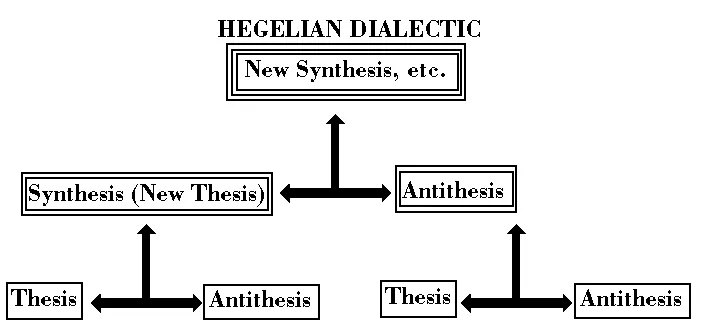
Thesis, antithesis are a constant dance. Hegel’s determinate negation matters here because it does not merely say, this is wrong, and this is right. It says, this is wrong in a way that reveals what is missing. The negation has shape. The failure is informative.
Synthesis, then, is not compromise. It is a reframing that preserves something real from both sides while making the original dispute feel too narrow to carry the weight you put on it. Reality is far from a black and white binary, and it gets you closer to this, The interesting move is usually not “find a better solution” but “change what the problem is about.”
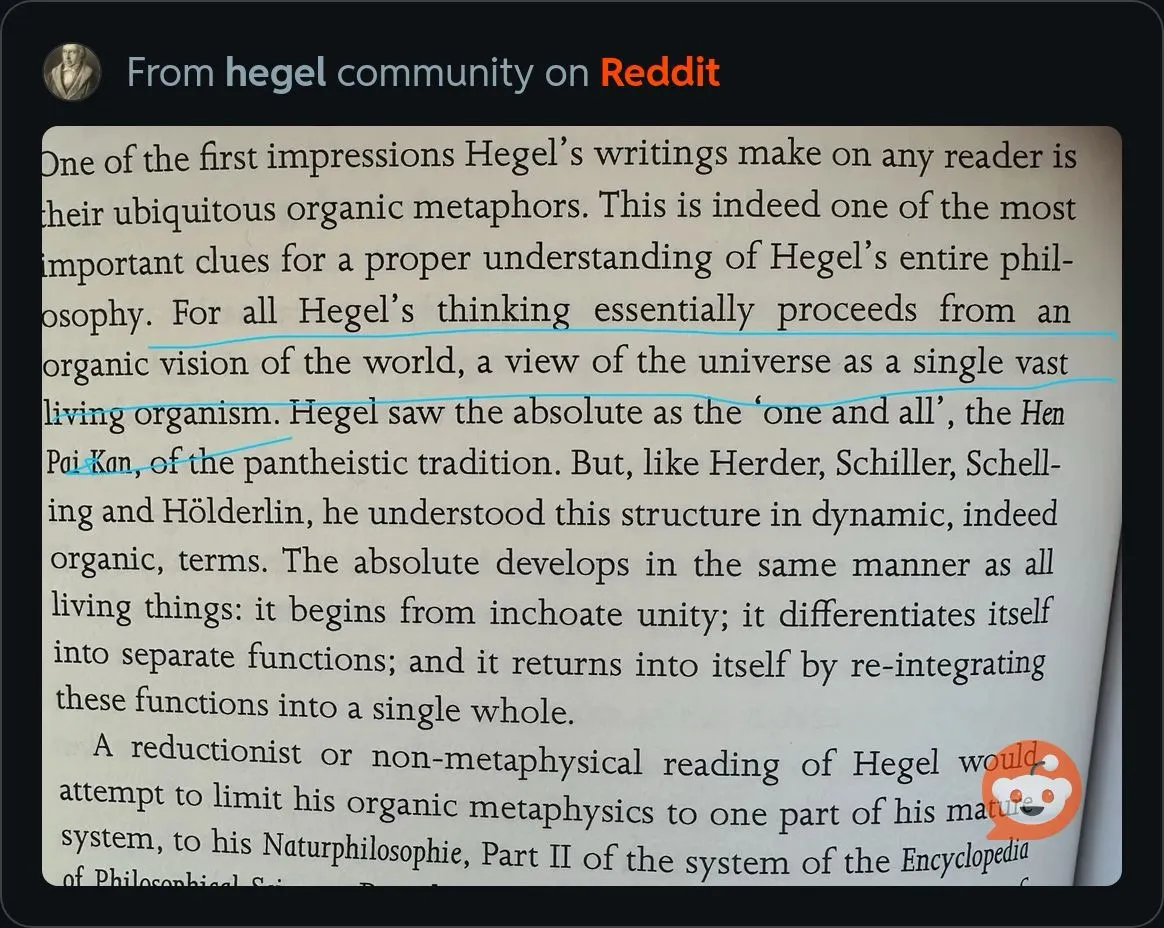
Hegel’s views on synthesis between thesis and antithesis can be viewed in juxtaposition to his view that nature is an evolving organism striving towards progress as indicated here:
In this attempt to arrive at a better synthesis, there are a lot more attempts here towards framing and reframing the ideas and their supporting questions. One could find more such exercises on the framing techniques from George Lakoff’s book — Metaphors we live by. The author doesn’t specifically use the dialectic, but it comes forth in the way he constantly evolves the shaping of the framing, to come to a better framing. For eg, the “immigrant neighbourhood” problem then evolves into a “shared belonging” problem which is much more solvable from both ends of the political spectrum due to the more inclusive framing.
| Old frame | New frame | How this helps? |
|---|---|---|
| Immigrant neighborhood decline is a “housing / public order” problem | It is a “shared belonging and memory” problem | Instead of policing difference, you build common identity through story exchange, which reduces alienation and makes cooperation possible |
| Integration of disabled people is a “care delivery” problem | It is an “abilities and contribution” problem | You stop treating people as burdens to manage and start designing roles through which they participate in society |
| Nightlife violence is a “crime control” problem | It is an “urban hospitality / festival infrastructure” problem | You redesign flows, toilets, signage, transit, and care, making the environment less violence-producing |
| Youth employment is a “recruitment / loyalty” problem | It is an “identity and attractiveness” problem | Institutions stop presenting as bureaucratic gatekeepers and become places young people actually want to join |
| Social housing failure is a “buildings” problem | It is a “social fabric” problem | You stop defaulting to demolition and start repairing networks, dignity, trust, and local belonging |
A neighborhood in decline looks like a housing or public-order problem until someone reframes it as a problem of belonging, shared memory, and social contact. Nightlife violence looks like a crime problem until someone reframes it as festival infrastructure: flows, toilets, transport, signage, places to cool down.
Even in the current context, AI-led job layoffs are usually framed as job-loss, versus innovation. One side warrants that the machines are coming for labour, and institutions should slow-down/regulate the usage as much as possible. The other side thinks everything is a positive-sum game, and should be treated with the foresight that even more abundance would be bestowed. Even here, a better framing from a hegelian dialectic can emerge, which could be that the real “question behind the question” is that we need institutions to better redistribute judgement..
By means of this agent skill, it was also shown to me that AI agents can also help us with this exercise.
Especially, when we also see that humans are also not quite natural in holding this way of reasoning, and counter-reasoning. We can probably hold one position quite strongly, but become worser as we hold more opposite positions too with equal force, evidence and emotional seriousness. It is most likely to be lopsided in one direction.
Coming back to the usage of this Hegelian dialectic skill, it is a process which goes through different phases: in the first phase, there is socratic questioning to uncover assumptions behind the questions posited. then it grounds the domain to ground the questions in the specifics. Then it creates two monks, each calibrated to carry the belief burden, plus targetted research directives for position specific evidence. both these electric monks write fully positioned essays to steelman their sides. This is purposefully spawned in separate sessions with no shared context, so that there is no path which is crossing over, and no context rot. With this approach, we look for “clinks in the armor”, especially what we’re aiming for is a state of self-sublation, where each position’s own logic can potentially undermine itself. after this destructive dissolution, then comes creative induction, where the important atomic bits are brought together and recombined alongside the monks’ material. Then comes sublation, where both electric monk A, and electric monk B are cancelled as complete truths, and a new “framing” emerges. This is what happened with politics as well, when capitalism got cancelled, and communism got cancelled too, and what emerged was a synthesis/antithesis dance, and then finally, “libertarian democracy”.
This is how the phases in this dialectic looks like as outlined by the author on GitHub:
The process has seven phases.
Phase 1: Elenctic Interview + Research — surface the real contradiction
The orchestrator interviews you Socratically — surfacing hidden assumptions, finding the deepest version of the contradiction, and identifying your belief burden. Then it researches the domain to ground both sides in specifics. The interview surfaces what you’re actually wrestling with; the research ensures the downstream arguments are grounded in specifics, not generics.
Phase 2: Generate Electric Monk Prompts — calibrate the belief assignments
The orchestrator crafts two prompts — one per Monk — calibrated to your specific belief burden. Each prompt includes framing corrections that prevent the Monk from falling into the obvious, boring version of the argument, plus targeted research directives for position-specific evidence.
Phase 3: Spawn the Electric Monks — two fully committed position essays
Two separate AI agents — each in a fresh, isolated context — write fully committed position essays. They don’t hedge. They don’t try to be balanced. Each one inhabits its position and makes the absolute strongest case. Spawning them in separate sessions with no shared context produces structural decorrelation — genuinely different reasoning paths, not the same analysis with different conclusions bolted on.
Phase 4: Determinate Negation — find where each argument undermines itself
The orchestrator analyzes both essays to find: where each position’s own logic undermines itself (self-sublation), what both sides implicitly agree on without realizing it (shared assumptions), and the specific way each position fails — not “it’s wrong” but “it fails in THIS way, which points toward THIS thing that’s missing.”
Then comes Boyd’s destructive deduction: shatter both arguments into atomic parts, break the correspondence between each position and its constituents, and scatter them into what Boyd calls a “sea of anarchy.” Then the creative induction: find common qualities, attributes, or operations among the scattered parts to build cross-domain connections that were invisible when the parts were trapped inside their original positions. In Round 2+, lateral creativity interventions (compressed conflicts, random Wikipedia domain injection, metaphor generation) inject genuinely external material before the decomposition, so it gets shattered and recombined alongside the monks’ material.
Phase 5: Sublation (Aufhebung) — synthesize something neither side could reach
The orchestrator generates a synthesis that simultaneously cancels both positions as complete truths, preserves the genuine insight in each, and elevates to a new concept that transforms the question itself.
This is not compromise. It’s not “use A for some cases and B for others.” It’s a reconceptualization — something neither Monk could have conceived from within their frame, but which, once stated, makes the original contradiction predictable. The synthesis is an abductive hypothesis: what would make it unsurprising that both Monk positions exist with genuine evidence? After drafting, a reversibility check (from Boyd) traces each claim back to specific atomic parts from the decomposition — untraceable claims get flagged as either confabulation or new insights needing their own evidence.
Phase 6: Validation — did the Monks feel elevated or defeated?
Both Monks evaluate the synthesis: were they elevated (their core insight preserved within something larger) or defeated (their position just dismissed)? Then a hostile auditor — a fresh agent with no position — attacks the synthesis for hidden assumptions, compromise disguised as transcendence, structural flaws, and runs its own reversibility check (can each claim trace to material in the essays, or is the synthesis just one monk’s structure wearing the other’s vocabulary?).
Phase 7: Recursion — where the real value lives
Each synthesis generates new contradictions. The orchestrator proposes 2–4 directions; you choose which to pursue. The process repeats — and each round gets sharper, pulling in new cross-domain material that the previous round made relevant.
The first round is calibration — the least insightful output. By Round 2–3, the dialectic has dug past the obvious framing into territory that neither you nor the Monks could have reached from the starting question.
This is another one of the commentaries by a person who used this to test the dialectic skill to help answer the question of “ React versus Vue” framework better..
In test runs, a React/Vue dialectic evolved from “corporate lab vs. auteur” into a “co-evolutionary arms race” framework. An institutional identity dialectic went through seven cycles, pulling in Gödel’s incompleteness theorem, Coasean transaction costs, and jurisprudential concepts that had nothing to do with the original question — but were essential by the time the dialectic reached them.
Read more
- Home is where the feeling of home residesreflections
- Notes on doing most good, doing some good, and living goodphilanthropy
- Notes on Londontravel
- 18 key ideas from reading Henrik Karlsson this monthwriting
- Venn-diagram based decision makingmathematics
- Co-creative loops are everywheremental-models
- Life lessons and hot takes from my 30slifestyle
- Building a skill for coherent science illustrationsscience
- My agentic engineering workflow (step by step)agentic-coding
- Hammock driven developmentagentic-coding
- Peculiar ways number three fits into our funny little brainsmental-models
- AI sandwich as a defacto principle for anything agentic engineering relatedagentic-coding
- Authority in the guise of evidencecritical-rationalism
- Map is not the territoryphilosophy
- Self hypnosis as a manifestation ritualmeditation
- How I prepare for tough negotiations nowadaysnegotiation
- When should we steelthread somethingproduct-development
- Breadboarding, shaping, slicing, and steelthreading solutions with AI agentsproduct
- Healthy conflict in teams have a tipping pointteam-building
- How I deslopify AI writingwriting
- How I started building softwares with AI agents being non technicalagentic-coding
- Read raw transcriptswriting
- Legible and illegible tasks in organisationsproduct
- L2 Fat marker sketchesdesign
- Writing as moats for humanswriting
- Beauty of second degree probesdecision-making
- Boundary objects as the new prototypesprototyping
- One way door decisionsproduct
- Finished softwares should existproduct
- How I periodically rank my rough draftsobsidian
- Flipping questions on its headinterviewing
- Vibe writing maximswriting
- How I blog with Obsidian, Cloudflare, AstroJS, Githubwriting
- How I build greenfield apps with AI-assisted codingagentic-coding
- We have been scammed by the Gaussian distribution clubmathematics
- Classify incentive problems into stag hunts, and prisoners dilemmasgame-theory
- I was wrong about optimal stoppingmathematics
- Thinking like a shipmental-models
- Hyperpersonalised N=1 learningeducation
- New mediums for humans to complement superintelligenceagentic-coding
- Maxims for AI assisted codingagentic-coding
- Virtual bookshelvesaesthetics
- It's computational everythingtrends
- Public gardens, secret routesdigital-garden
- Git way of learning to codeagentic-coding
- Style Transfer in AI writingagentic-coding
- Understanding codebases without using codeagentic-coding
- Vibe coding with Cursoragentic-coding
- Virtuoso Guide for Personal Memory Systemsmemory
- Writing in Future Pastwriting
- Publish Originally, Syndicate Elsewhereblogging
- Poetic License of Designdesign
- Idea in the shower, testing before breakfastsoftware
- Technology and regulation have a dance of ice and firetechnology
- How I ship "stuff"software
- Writing is thinkingwriting
- Song of Shapes, Words and Pathscreativity
- How do we absorb ideas better?knowledge
- Read writers who operatewriting
- Brew your ideas lazilyideas
- Trees, Branches, Twigs and Leaves — Mental Models for Writingwriting
- Compound Interest of Private Noteswriting
- Conceptual Compression for LLMsagentic-coding
- Meta-analysis for contradictory research findingsdigital-health
- Proof of workproduct
- Gauging previous work of new joinees to the teamleadership
- Task management for product managersproduct
- Beauty of Zettelswriting
- Stitching React and Rails togetheragentic-coding
- Exploring "smart connections" for note takingwriting
- Deploying Home Cooked Apps with Railssoftware
- Repetitive Copypromptingwriting
- Questions to ask every decadejournalling
- Balancing work, time and focusproductivity
- Hyperlinks are like cashew nutswriting
- Brand treatments, Design Systems, Vibesdesign
- How to spot human writing on the internetwriting
- Can a thought be an algorithm?product
- Opportunity Harvestingcareers
- Everything is a prioritisation problemproduct
- Nowlifestyle
- How I do product roastsproduct
- The Modern Startup Stacksoftware
- In-person vision transmissionproduct
- How might we help children invent for social good?social-design
- The meeting before the meetingmeetings
- Design that's so bad it's actually gooddesign
- Lessons learnt interview prepping for product rolesinterviewing
- Obsessing over personal websitessoftware
- English is the hot new programming languagesoftware
- Better way to think about conflictsrisk-management
- The role of taste in building productsdesign
- Dear enterprises, we're tired of your subscriptionssoftware
- Products need not be user centereddesign
- World's most ancient public health problemsoftware
- Pluginisation of Modern Softwaredesign
- Let's make every work 'strategic'consulting
- Making Nielsen's heuristics more digestibledesign
- Startups are a fertile ground for risk takingentrepreneurship
- Insights are not just a salad of factsdesign
- Minimum Lovable Productproduct
- Methods are lifejackets not straight jacketsmethodology
- How to arrive at on-brand colours?design
- Minto principle for writing memoswriting
- Importance of Whytask-management
- Quality Ideas Trump Executionsoftware
- Why I prefer indie softwareslifestyle
- Use code only if no code failscode
- Self Marketing
- Personal Observation Techniquesdesign
- Design is a confusing worddesign
- A Primer to Service Design Blueprintsdesign
- Rapid Journey Prototypingdesign
- Visualise detailed file structures on CLIcli
- Do's and Don'ts of User Researchdesign
- Design Manifestodesign
- Complex project management for productproducts
- How might we enable patients and caregivers to overcome preventable health conditions?digital-health
- Pedagogy of the Uncharted — What for, and Where to?education
- Future of Equity with Ludovick Petersinterviewing
- Future of Ageing with Mehdi Yacoubiinterviewing
- Future of Tacit knowledge with Celeste Volpiinterviewing
- Future of Mental Health with Kavya Raointerviewing
- Future of unschooling with Che Vanniinterviewing
- Future of Rural Innovation with Thabiso Blak Mashabainterviewing
- Future of work with Laetitia Vitaudinterviewing
- How might we prevent acquired infections in hospitals?digital-health
- The why to endure any howentrepreneurship
- Design education amidst social tribulationsdesign
- How might we assist deafblind runners to navigate?social-design