Notes on London

-
Lévi-Strauss, the anthropologist who studied how early human groups revered animals and plants, noticed how tribal totems kept manifesting in every culture he studied. One clan had the black cockatoo, and the other clan had the white cockatoo. The choice of the cockatoo was not entirely arbitrary, they were inherited from the local flora and fauna. Whenever I take a walk through London, I’m observing similar totems similar such as cockatoos that are revered, as described by Strauss. You have the Daunt or the Notting Hill tote bag, the bright orange Penguin paperback, the MUBI beige cap, the Fortum and Mason bag, the Brompton folded beneath a pub table, all these are totems demarcating the London social world.
-
The Cities and Ambition essay by Paul Graham talks about the true unique gestalt captured in the air, in the city. The main thesis is that every city is whispering a different message into your ear — New York is telling you to make money, Boston or Cambridge is telling you to be smarter etc. London as a person has constantly been screeching into my ears “high-culture”. What I mean by “high culture” is not the high-fashion kind, but it’s just that culture itself is held in high esteem. Posh, sophisticated, and suave. And high-culture is everywhere, the V&A, the Wallace Collection, the National Gallery, the Royal Academy, the Tate Britain, the Barbican, the Royal Opera House, the Kenwood House, the Liberty, the Fortnum & Mason etc..
-
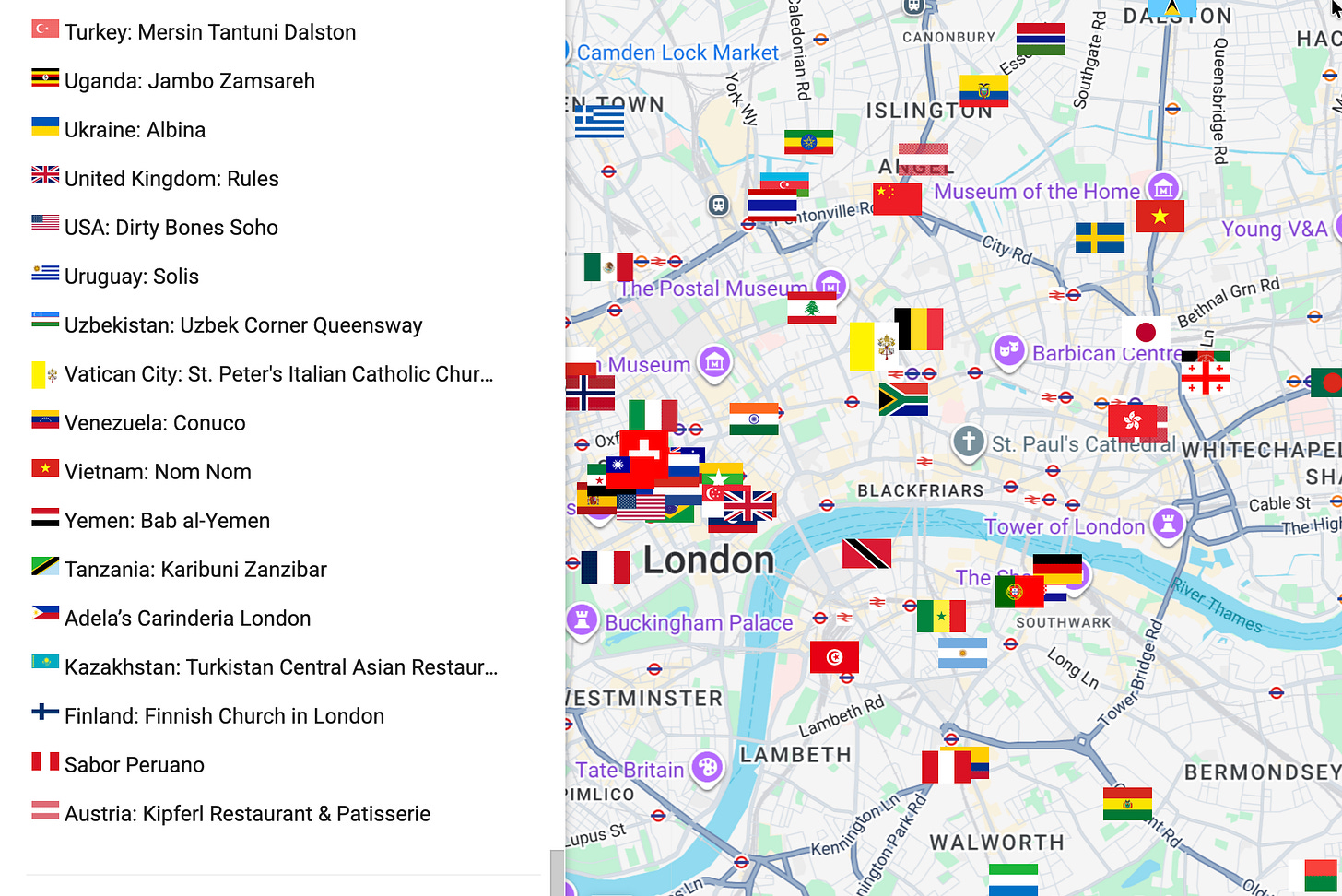
There is also a restaurant for every nationality in this world here in London. I’d run this claim with ChatGPT and Reddit to see the veracity of this claim, and surprisingly I found this map which contains exactly that! All the countries and the restaurants listed here (contains roughly 195 of them). “Diversity is our strength” is the selling point that brought a lot of diverse ethnic groups across the world here in to London in the first place.
-
Talking about books, everyone around you is reading books everywhere. With Londoners, approaching a stranger and making contextual inquiries fascinated by the book someone is reading is also socially acceptable. Performative reading exists, and in a way, it’s quite okay, and that’s good?
-
London also has a surprising range of weird and wonderful potatoes. At M&S, You have the Maris Piper, the King Edward, the Charlotte, the Jersey Royals, the freshly born, baby, new potatoes, red varieties, the baking potatoes, the salad potatoes, and so on. There is something distinctly British about this. Potatoes here are treated almost like a small taxonomy of ingredients: one for roasting, another for mash, another for boiling, another for salads. The taxonomy of potatoes you find here, are likened to how you have a similar such taxonomy when it comes to rice in India — like how you have the jeeraga sambha rice for biryani, matta for morsel soups in Kerala, idli rice for fermentation, etc.
-
I once sat in front of a quadragenarian British white male at a Local Pret store. He despised me for sitting in front of him and wanted to avoid gazing at me directly. He then asked if I could sit somewhere else. I was surprised by his request and mentioned that I’m comfortable sitting here, as long as he is not expecting someone else to be seated in the place I’d taken. He then shouted at me for being too ugly, and said that I was disturbing his line of sight. I froze in a state of shock. This was not subtle at all; this was on-the-face, and about-the-face. In this frenzied state, I just obeyed, and took another seat, and felt, perhaps for the first time, how power worked and how being victimized felt. As an immigrant at that time, still looking for a job at that time, and with nothing permanent, I’d chosen not to fight back. Despite encountering similar such incidents on buses, trains, and in cafes, I prefer not to put the blanket of racism over a selective few profiles in a stereotypical format, but racism exists in London, and it’s not an illusionary black swan.
-
As I commute in and around Kings Cross, London, I’ve also noticed a particular dialect in the surrounding regions of central London. Initially I was thinking if this is how London spoke. Apparently, this is the ‘regional accent’ of the young working-class, an almost hybrid dialect by the name of Multi-cultural London (MLE), and Kate Fox in her book, Watching the English talks about how MLE incorporates various elements of the Carribean, South Asian, and African American speech patterns and vocabulary. In MLE, the ‘like’ becomes ‘lahke’, ‘that’ becomes ‘dat’, and virtually every sentence ends in ‘innit?’ or ‘y’get me?’ It sometimes even sounds a bit like fast pidgin, or a London version of a blasphemous creole.
-
Patriotism or any form of flag-cheering jingoism is virtually absent to non-existent here. Londoners do come out of their self-imposed exile of closet patriotism when there is especially a football game. The recent England games as a part of the FIFA was a spectacle, as the pubs nearby only started serving beer in plastic cups instead of glass. Any glass held by a Londoner has a high chance of being smashed and thrown at. Waving the national flag, cheering and dancing in the streets is a rare Pokémon to spot (I’ve never seen one as such)
-
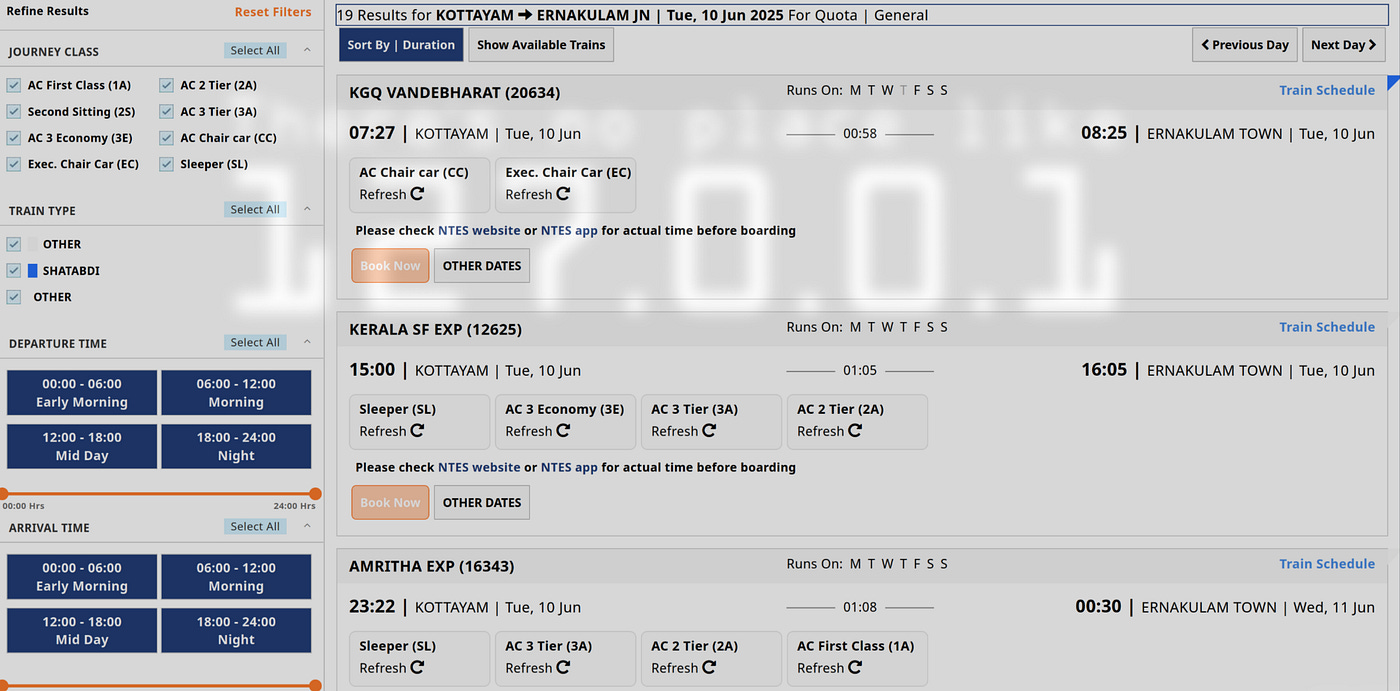
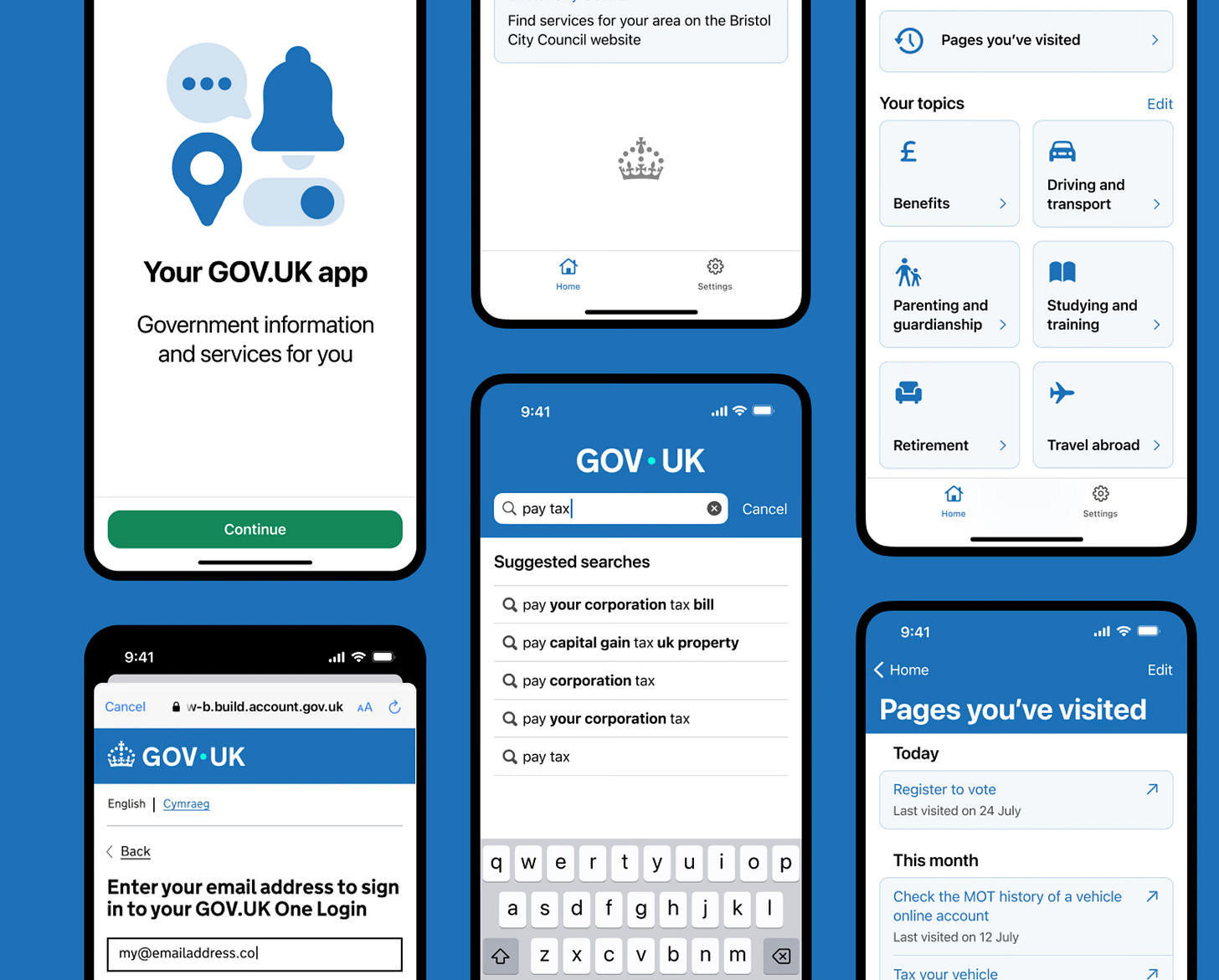
What I observed about London, and UK in general is the care and undue attention they give for the design of everyday government software. This is a breath of fresh air compared to the Indian government’s official railway website (IRCTC). As a contrast, the IRCTC site has way too many buttons congested, sadly replicating the same in-person general compartment experience in a crowded Indian local train. Too much options presented simultaneously etc, so much so that it’s an epitome of broken UX principles. Whereas, the websites and the apps of NHS, and GOV.UK are extremely well-detailed.
- By well designed, I’m not just talking about designerly visuals, layouts and pixels, crispy typography etc (that’s good too), What I mean by “well designed” is the importance given to second order, third order effects and the consideration given in the UX, UI and all that to even handle them. Even for a simple name input of a person, an ordinary service might be like, ok, we need first name, last name, so let’s capture that. GOV.UK is more like, ok, we need to identify the name of the person? why do we actually need their name in the first place? do we need it’s constituent parts? first name? last name? what happens when someone’s name doesn’t fit in to this? does failure in creating a name prevent someone from a legal entitlement? this is the level at which this has been thought through. The impression I’m getting from using the gov.uk site is that they’ve housed a philosopher-in-residence to ask such key grandiose questions..(they even have established principles on their website, and what a good ‘form’ should be designed as)
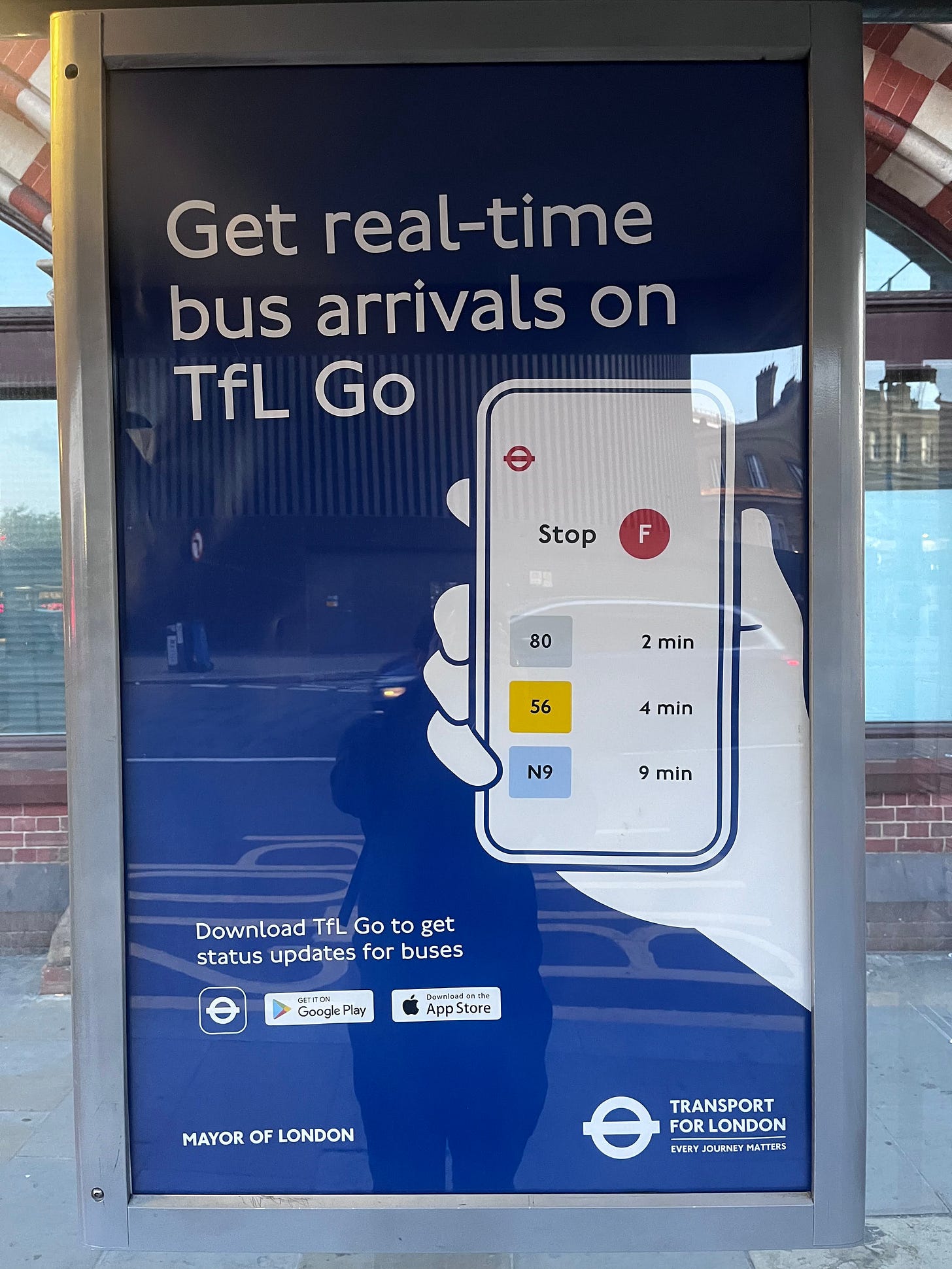
- Talking about crispy typography which I left off expanding in the previous bullet point, the public display of fonts are quite tasteful too. One day, I spent almost 45 minutes immersed in a poster, which was printed on the side-panel of a bus stop. I was in love with the shape of ‘U’ (sorry Ed Sheeran). The way the shape of C was curving, and how the letter, ‘f’ stood elegantly on the invisible line without being toppled by its own weight. The dot above the letter i, the tittle. I was so much in awe, that I missed a couple of buses that were headed to my destination. I really don’t care. For the curious, I’m talking about the Johnston 100 Typeface commonly used across TfL (Transport for London)
-
Even the public services are well thought through. London Underground map is arranged in the layout of a circuit diagram, ensuring that it serves the objective, even at the cost of compromising on the geographic accuracy.
-
A friend of mine who visited me in London, and as my favourite past-time is with any such visit would be to go on a long rational-flanêur type walk across the streets. When encountered with this question on “what makes you stay in London? convince me to settle here..” I immediately exclaimed, “fresh air” immediately. Probably the easiest way not to die is with better air quality. Compared to 150-400+ across Delhi/Lahore, London is at 25+ in the US AQI scale. Obviously every place has it’s own charm, but if you’re preferring the side of environment, park conservation, air quality etc, London has that charm.
-
London is not exactly the birthplace of the age of reason, Enlightenment. Enlightement has indeed been polycentric with various such pockets where innovators and freethinkers thrived, and the London coffeehouses were a key part of how this culture became much more mimetic. You had the usual suspects such as Locke, Descartes, Hume, Kant, Montesquieu, Voltaire etc visiting such coffee houses. The British Museum has a great collection of Enlightenment related antiques.
-
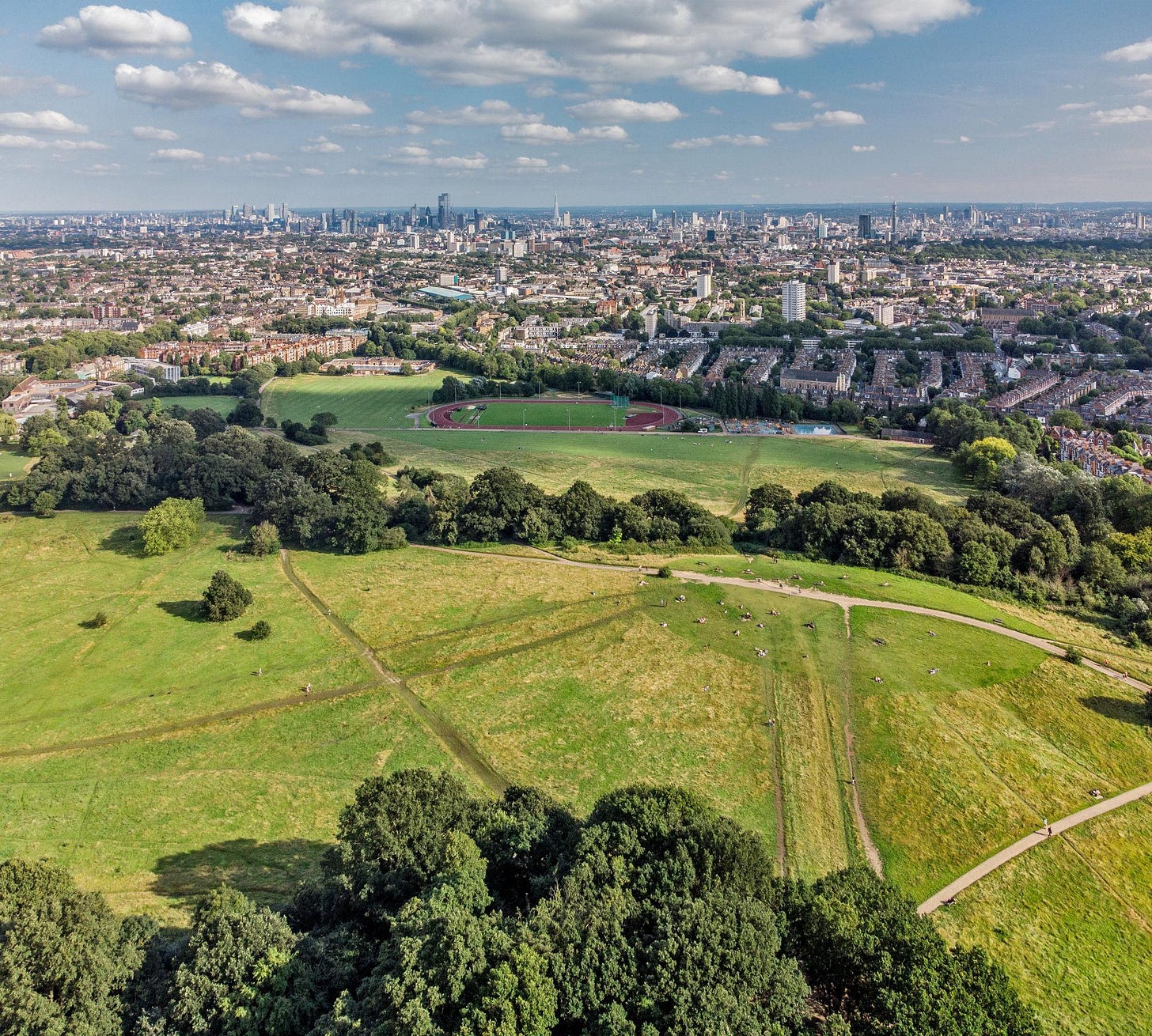
The London metropolis grew around something that retained the morphology of common land. This claim is quite evident when we look at places like Hamstead Heath, or Hyde Park. The city grew around the forest, and visiting these places make this claim evident.
-
Not just these bigger parks, but you had had 100s of garden squares, of which several hundred were laid out in residential areas from seventeenth to nineteenth centuries. Instead of putting houses along a road and giving each house a large private garden, developers could concentrate the greenery into one substantial shared interior landscape and surround it with relatively dense terraces. This, I could see more of, especially in Elephant and Castle, and surrounding regions.
-
Healthcare service does a great job of triaging the most important and urgent, and giving them the utmost care, and the least important and least urgent, not giving them a flying duck. I had a headache once, and as it was a sudden one while waking up early, the NHS triaging system flagged this off as a red alert, and as such, because their conventional ambulance would have taken 15 minutes extra, they arranged a dedicated Uber (yes a private call taxi arranged by the government to expedite the process). They took me in, and checked my vitals at the hospital only to realise that it’s not “life threatening”. When that happened, they made me wait for 6 hours for a normal consultation, and in a span of a couple of hours, I experienced the full spectrum, from the high-importance, high-urgency care, to the low-importance, low-urgency care.
-
Homelessness is a real problem, and you see a lot of folks out there, on the streets, sleeping rough. Despite the shortcomings in their plight, I’ve usually observed them to be quite polite and courteous while asking for alms. I’ve seen more sentences started with “Could you please..”..
-
Drivers also strike great conversations, and I’ve enjoyed the Uber rides I’ve had. Weather and geography are great conversation starters. Commuters are expected to have a good grip of the railway lines, major commute connections etc. Conversations usually start with how bad the weather is, and then it goes into ‘Where do you live’.. and ‘How easy is the commute’ etc, and all these are just prep work getting us acclimatised enough to then talk about how hard life is, and what are our common struggles here..At the end of the ride, we reach the destination, and we’ve also moved from strangers to acquaintances.
Read more
- Home is where the feeling of home residesreflections
- Notes on doing most good, doing some good, and living goodphilanthropy
- 18 key ideas from reading Henrik Karlsson this monthwriting
- Venn-diagram based decision makingmathematics
- Co-creative loops are everywheremental-models
- Life lessons and hot takes from my 30slifestyle
- Building a skill for coherent science illustrationsscience
- My agentic engineering workflow (step by step)agentic-coding
- Hammock driven developmentagentic-coding
- Peculiar ways number three fits into our funny little brainsmental-models
- AI sandwich as a defacto principle for anything agentic engineering relatedagentic-coding
- Authority in the guise of evidencecritical-rationalism
- Map is not the territoryphilosophy
- Self hypnosis as a manifestation ritualmeditation
- Hegelian dialectic for structured reasoning with AI agentsphilosophy
- How I prepare for tough negotiations nowadaysnegotiation
- When should we steelthread somethingproduct-development
- Breadboarding, shaping, slicing, and steelthreading solutions with AI agentsproduct
- Healthy conflict in teams have a tipping pointteam-building
- How I deslopify AI writingwriting
- How I started building softwares with AI agents being non technicalagentic-coding
- Read raw transcriptswriting
- Legible and illegible tasks in organisationsproduct
- L2 Fat marker sketchesdesign
- Writing as moats for humanswriting
- Beauty of second degree probesdecision-making
- Boundary objects as the new prototypesprototyping
- One way door decisionsproduct
- Finished softwares should existproduct
- How I periodically rank my rough draftsobsidian
- Flipping questions on its headinterviewing
- Vibe writing maximswriting
- How I blog with Obsidian, Cloudflare, AstroJS, Githubwriting
- How I build greenfield apps with AI-assisted codingagentic-coding
- We have been scammed by the Gaussian distribution clubmathematics
- Classify incentive problems into stag hunts, and prisoners dilemmasgame-theory
- I was wrong about optimal stoppingmathematics
- Thinking like a shipmental-models
- Hyperpersonalised N=1 learningeducation
- New mediums for humans to complement superintelligenceagentic-coding
- Maxims for AI assisted codingagentic-coding
- Virtual bookshelvesaesthetics
- It's computational everythingtrends
- Public gardens, secret routesdigital-garden
- Git way of learning to codeagentic-coding
- Style Transfer in AI writingagentic-coding
- Understanding codebases without using codeagentic-coding
- Vibe coding with Cursoragentic-coding
- Virtuoso Guide for Personal Memory Systemsmemory
- Writing in Future Pastwriting
- Publish Originally, Syndicate Elsewhereblogging
- Poetic License of Designdesign
- Idea in the shower, testing before breakfastsoftware
- Technology and regulation have a dance of ice and firetechnology
- How I ship "stuff"software
- Writing is thinkingwriting
- Song of Shapes, Words and Pathscreativity
- How do we absorb ideas better?knowledge
- Read writers who operatewriting
- Brew your ideas lazilyideas
- Trees, Branches, Twigs and Leaves — Mental Models for Writingwriting
- Compound Interest of Private Noteswriting
- Conceptual Compression for LLMsagentic-coding
- Meta-analysis for contradictory research findingsdigital-health
- Proof of workproduct
- Gauging previous work of new joinees to the teamleadership
- Task management for product managersproduct
- Beauty of Zettelswriting
- Stitching React and Rails togetheragentic-coding
- Exploring "smart connections" for note takingwriting
- Deploying Home Cooked Apps with Railssoftware
- Repetitive Copypromptingwriting
- Questions to ask every decadejournalling
- Balancing work, time and focusproductivity
- Hyperlinks are like cashew nutswriting
- Brand treatments, Design Systems, Vibesdesign
- How to spot human writing on the internetwriting
- Can a thought be an algorithm?product
- Opportunity Harvestingcareers
- Everything is a prioritisation problemproduct
- Nowlifestyle
- How I do product roastsproduct
- The Modern Startup Stacksoftware
- In-person vision transmissionproduct
- How might we help children invent for social good?social-design
- The meeting before the meetingmeetings
- Design that's so bad it's actually gooddesign
- Lessons learnt interview prepping for product rolesinterviewing
- Obsessing over personal websitessoftware
- English is the hot new programming languagesoftware
- Better way to think about conflictsrisk-management
- The role of taste in building productsdesign
- Dear enterprises, we're tired of your subscriptionssoftware
- Products need not be user centereddesign
- World's most ancient public health problemsoftware
- Pluginisation of Modern Softwaredesign
- Let's make every work 'strategic'consulting
- Making Nielsen's heuristics more digestibledesign
- Startups are a fertile ground for risk takingentrepreneurship
- Insights are not just a salad of factsdesign
- Minimum Lovable Productproduct
- Methods are lifejackets not straight jacketsmethodology
- How to arrive at on-brand colours?design
- Minto principle for writing memoswriting
- Importance of Whytask-management
- Quality Ideas Trump Executionsoftware
- Why I prefer indie softwareslifestyle
- Use code only if no code failscode
- Self Marketing
- Personal Observation Techniquesdesign
- Design is a confusing worddesign
- A Primer to Service Design Blueprintsdesign
- Rapid Journey Prototypingdesign
- Visualise detailed file structures on CLIcli
- Do's and Don'ts of User Researchdesign
- Design Manifestodesign
- Complex project management for productproducts
- How might we enable patients and caregivers to overcome preventable health conditions?digital-health
- Pedagogy of the Uncharted — What for, and Where to?education
- Future of Equity with Ludovick Petersinterviewing
- Future of Ageing with Mehdi Yacoubiinterviewing
- Future of Tacit knowledge with Celeste Volpiinterviewing
- Future of Mental Health with Kavya Raointerviewing
- Future of unschooling with Che Vanniinterviewing
- Future of Rural Innovation with Thabiso Blak Mashabainterviewing
- Future of work with Laetitia Vitaudinterviewing
- How might we prevent acquired infections in hospitals?digital-health
- The why to endure any howentrepreneurship
- Design education amidst social tribulationsdesign
- How might we assist deafblind runners to navigate?social-design