Co-creative loops are everywhere

When we see two events, A and B, our natural tendency is to place a succinct left-to-right arrow —>, in between two events A and B. It hardly crossed my mind sometimes that A and B could be feedback loops. A could effect B, and B could effect A, and the effect of B effecting A, could effect the effect of A effecting B…. . Why complicate things isn’t it? We will just leave it as it is, after all simplicity is the ultimate sophistication..
Okay, enough of abstractions, let’s talk specifics:
-
I see a thing called a “problem”, and another thing called a “solution”, and I imagine the problem leading to the solution, or so the thinking goes.
-
I see a person being “religious”, and a set of rituals called “practice”, and I imagine the belief came first and the practice merely expressed it.
-
I see “aging” and “disease”, and I imagine aging as the background condition, while diseases are the foreground enemies we are meant to defeat.
As you could notice from the above examples, I kept mistaking the loop, for a A —> B type line.
Most of what we see around the world don’t work in a capital “L” linear way. by the end of this essay, I hope I’ve driven the point around self reinforcing feedback loops strong enough..
And even August Kekule, the German chemist famous for the discovery of the Benzene ring, had made the same mistake (but he did learn from his mistake, and was able to unearth the chemical structure of Benzene). He thought the benzene was a linear chain of carbon atoms, but the mathematics of the chemistry didn’t just add up if it were to be a linear chain.
To him, this was an unsolved enigma, a ghost in the molecular machine. So he was taking a sweet nap on a rocking chair in front of the Victorian fireplace, when inspiration struck him:
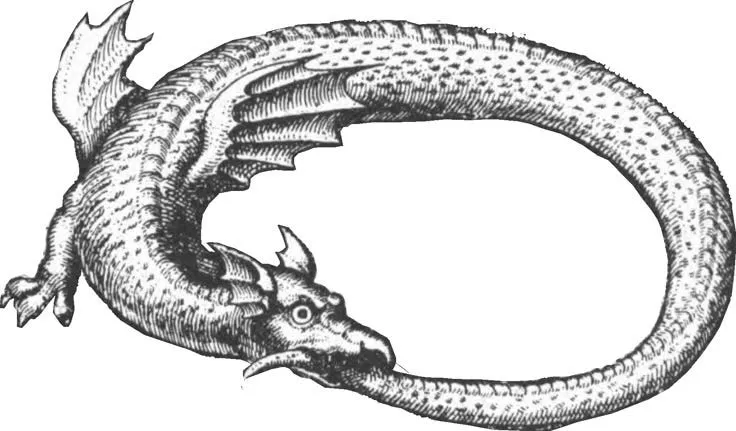
And in that sudden hallucinogenic drift, he noticed the benzene atoms dancing, whirling like a molecular conga line, before cooling into a ring and biting its own tail. The mythical ouroboros appeared.
How many of us are making a similar such mistake? Are we all mistaking the loop for a line? Could this visual of a snake eating its own tail, serve as metaphysical guide for us to think through reality and how everything is connected? Let’s look at these patterns in more detail:
problem ↔ solution
In my first career arc of being an “fresher”, an inexperienced product newbie, I used to think of the problem and the solution as a traditional waterfall. You think of the problem, define the constraints, check. Head to explore solutions. Check. Finalise the solution. Check. And then pass it on, and move on to the next problem <> solution. It was supposed to always point right —>, from the problem and into the solution..
Jumping into “solutions” prematurely, before understanding the problem was also considered to be offensive in some circles.. as we have not thought through the problem completely, and that we’re not qualified to take such a serious move so early. This was the designerly equivalent of the cardinal sin.
It took me that entire decade and a Masters education in design methodology to help me realise that it seldom works that way, in reality. Problem and solution pairs are having a kekulean dance with each other, eating each others tail, biting and pouncing at each other until they end up with a better problem and solution pair. There is a co evolution which we miss noticing. In retrospect, it felt fairly obvious and I was scrutinising myself as to why I needed a masters education in design theory for me to be educated enough to know this..
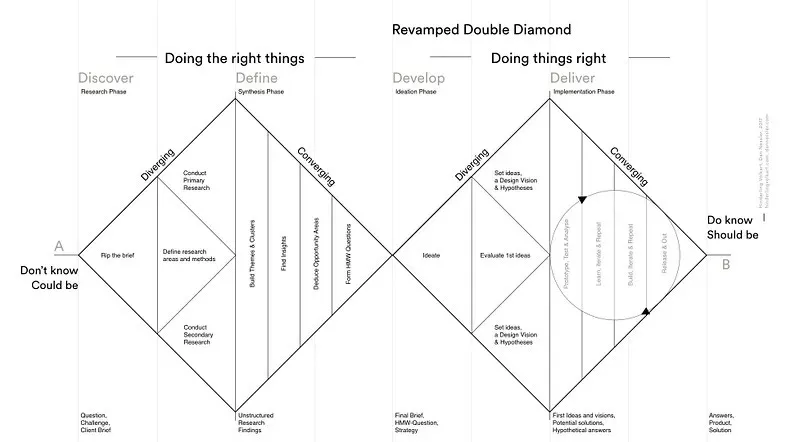
Timing through solutions can help us think through the problems which can also help us think through better solutions.. while working on a recent creative experiment, I spent much more time cooking up multiple variations of the concepts through prototypes. I could have also gone the problem definition route first, doing informational interviews first, and assess which pain points are more important, and after all that, I could have then considered possible solutions. But the reality was quite zigzaggy. Those prototypes then served as better tools for enquiry helping me reach traction and momentum through them, the image of the double-diamond which is flashed left, right, and centre as a part of the designers indoctrination program across various universities seldom withstands contact with reality, this theory wrinkles and perishes with usage, as like other processes, this is also not a linear conveyor belt style causality..
belief ↔ practise
I also then realised that I make the same mistake in other aspects too — bidirectional pairs, unidirectional pairs. This topic keeps coming up again and again..
Let’s talk about belief and practise. Tanya Luhmann, the American professor explores the relationship between belief and practise in her book—How God becomes real. She describes herself as “anthropologist of mind”. In her quest to understand the way people represent thought itself, and the way those culturally varied representations shape the most intimate experience of life itself.
This is Nielsen describing his own experience reading this book:
Tanya M. Luhrmann has written a beautiful book exploring this question, “How God Becomes Real: Kindling the Presence of Invisible Others”. The book explores the idea that much of the purpose of religious practice is to help practitioners believe. This inverts conventional wisdom, with Luhrmann taking seriously the possibility that sometimes people aren’t worshipping because they believe, but rather believing because they worship. More generally: Luhrmann makes a compelling case that there is a much more complex relationship between belief and religious practice than you might naively suppose, and she explores some of that relationship.
I used to think that people who are “religious” by spirit, also do practise a lot of rituals because they’re religious. Atleast that was the notion I was used to hearing. However, Tanya explores a different dynamic where she suggests that practise itself by virtue of practise — practise instils belief.
Personally, I come from the other side of the spectrum where I want to be religious for some reason, and I lack embedding some rituals in my day to day. This thought that religion and practise are a co-evolutionary loop gives me great hope. I’ve envied my mom, and my sister in the way they have cultivated their faith through practise: which involves chanting Hanuman chalisa, Vishnu sahasranaamam, Lalitha sahasranaamam etc and various other Hindu japa mantras in the evenings as a part of their daily/weekly/occasional puja rituals.
Right now, It’s 6:15 PM at dusk, an auspicious time usually meant for evening prayers, and here I am talking about the process of Bhakti (practise of worship), rather than doing the practise itself. How ironic, but I will get there.
Religious belief isn’t something that’s easily attained or endowed with, and it’s hard to tilt towards a religious worshipper from a somewhat-agnostic mode, unless cultivated with practise:
Let me review a few of the moves Luhrmann makes in setting up her project. She points out, convincingly, that religious belief usually isn’t something easily attained, despite the fact that many theories of religion “presume that belief is direct and unproblematic – that in most cultures, people simply take spirit and the supernatural to be there. That doesn’t make sense. Gods and spirits cannot be seen. You cannot shake their hands, look them in the eye, or hear their voice when they speak. It seems odd to assume that people just take for granted that they are present.”
I find it weird when I say this, but knowing this theory has actually makes me more religious. It has given me more meaning to what’s interpreted as practise. From the day I read this book review article on the co-evolutionary loop phenomenon exhibited by religion and practise, I am not able to unsee these patterns applied across everywhere. And there are more..
aging ↔ disease
Now, the thinking here is Ageing → Disease, that as we age:
-
DNA damage accumulates.
-
Cells become senescent (they stop dividing but release inflammatory molecules).
-
Mitochondria become less efficient.
-
Stem cells lose their ability to repair tissues.
-
Chronic low-grade inflammation (“inflammaging”) increases, leading to more diseases, and ultimately death.
But now, increasingly, scientists are thinking that it is rather: Ageing ↔ Disease, instead of merely, Disease → Ageing.
With this U-turn in the direction of arrows, we have this bet that ‘aging itself is a disease’ which can be treated. And that part just blew my mind. We now have scientists trying to reverse the age of human cells, and we now have clinical trials trying to prove this in full swing. Newlimit is one such company, working in this bleeding edge of longevity with this same thesis.
“And by combating ageing itself as a disease, they want to combat all diseases.”
NewLimit uses RNA to switch on the combinations that make an old cell start acting young again. They already have a prototype that does this to human liver cells, healing the liver faster after injury and speeding up recovery from alcohol damage. the first human trial is set for 2027. Brian Armstrong’s company just raised $435M to do this.
What excites me from all this latest development in tech is not the fact that the age 120 stops being a fixed ceiling, or the fact that cellular reprogramming gives potential pathways to 150 years on average, but the fact that this all started with a smart framing of a statement that got flipped on its own head: “that ageing is a disease”.. who would have thought?
Most of us are primed to think linearly with “X causes Y” logic, but we have to adopt a systems thinking lens, and I’m trying to train myself here with the notion that everything is a system (X causes Y, which feedback’s into X again..), and it’s not easy..
To me, most of the smartest ideas out there starts with a unique counter-positioned framing, a view that shakes the world view, this creates a literal tear in the space-time continuum and leads to innovation, as a side effect..
I will keep hunting for more such co-creative systemic loops. And I hope to find more. After all, the whole world is just the snake eating its own tail…
Read more
- Home is where the feeling of home residesreflections
- Notes on doing most good, doing some good, and living goodphilanthropy
- Notes on Londontravel
- 18 key ideas from reading Henrik Karlsson this monthwriting
- Venn-diagram based decision makingmathematics
- Life lessons and hot takes from my 30slifestyle
- Building a skill for coherent science illustrationsscience
- My agentic engineering workflow (step by step)agentic-coding
- Hammock driven developmentagentic-coding
- Peculiar ways number three fits into our funny little brainsmental-models
- AI sandwich as a defacto principle for anything agentic engineering relatedagentic-coding
- Authority in the guise of evidencecritical-rationalism
- Map is not the territoryphilosophy
- Self hypnosis as a manifestation ritualmeditation
- Hegelian dialectic for structured reasoning with AI agentsphilosophy
- How I prepare for tough negotiations nowadaysnegotiation
- When should we steelthread somethingproduct-development
- Breadboarding, shaping, slicing, and steelthreading solutions with AI agentsproduct
- Healthy conflict in teams have a tipping pointteam-building
- How I deslopify AI writingwriting
- How I started building softwares with AI agents being non technicalagentic-coding
- Read raw transcriptswriting
- Legible and illegible tasks in organisationsproduct
- L2 Fat marker sketchesdesign
- Writing as moats for humanswriting
- Beauty of second degree probesdecision-making
- Boundary objects as the new prototypesprototyping
- One way door decisionsproduct
- Finished softwares should existproduct
- How I periodically rank my rough draftsobsidian
- Flipping questions on its headinterviewing
- Vibe writing maximswriting
- How I blog with Obsidian, Cloudflare, AstroJS, Githubwriting
- How I build greenfield apps with AI-assisted codingagentic-coding
- We have been scammed by the Gaussian distribution clubmathematics
- Classify incentive problems into stag hunts, and prisoners dilemmasgame-theory
- I was wrong about optimal stoppingmathematics
- Thinking like a shipmental-models
- Hyperpersonalised N=1 learningeducation
- New mediums for humans to complement superintelligenceagentic-coding
- Maxims for AI assisted codingagentic-coding
- Virtual bookshelvesaesthetics
- It's computational everythingtrends
- Public gardens, secret routesdigital-garden
- Git way of learning to codeagentic-coding
- Style Transfer in AI writingagentic-coding
- Understanding codebases without using codeagentic-coding
- Vibe coding with Cursoragentic-coding
- Virtuoso Guide for Personal Memory Systemsmemory
- Writing in Future Pastwriting
- Publish Originally, Syndicate Elsewhereblogging
- Poetic License of Designdesign
- Idea in the shower, testing before breakfastsoftware
- Technology and regulation have a dance of ice and firetechnology
- How I ship "stuff"software
- Writing is thinkingwriting
- Song of Shapes, Words and Pathscreativity
- How do we absorb ideas better?knowledge
- Read writers who operatewriting
- Brew your ideas lazilyideas
- Trees, Branches, Twigs and Leaves — Mental Models for Writingwriting
- Compound Interest of Private Noteswriting
- Conceptual Compression for LLMsagentic-coding
- Meta-analysis for contradictory research findingsdigital-health
- Proof of workproduct
- Gauging previous work of new joinees to the teamleadership
- Task management for product managersproduct
- Beauty of Zettelswriting
- Stitching React and Rails togetheragentic-coding
- Exploring "smart connections" for note takingwriting
- Deploying Home Cooked Apps with Railssoftware
- Repetitive Copypromptingwriting
- Questions to ask every decadejournalling
- Balancing work, time and focusproductivity
- Hyperlinks are like cashew nutswriting
- Brand treatments, Design Systems, Vibesdesign
- How to spot human writing on the internetwriting
- Can a thought be an algorithm?product
- Opportunity Harvestingcareers
- Everything is a prioritisation problemproduct
- Nowlifestyle
- How I do product roastsproduct
- The Modern Startup Stacksoftware
- In-person vision transmissionproduct
- How might we help children invent for social good?social-design
- The meeting before the meetingmeetings
- Design that's so bad it's actually gooddesign
- Lessons learnt interview prepping for product rolesinterviewing
- Obsessing over personal websitessoftware
- English is the hot new programming languagesoftware
- Better way to think about conflictsrisk-management
- The role of taste in building productsdesign
- Dear enterprises, we're tired of your subscriptionssoftware
- Products need not be user centereddesign
- World's most ancient public health problemsoftware
- Pluginisation of Modern Softwaredesign
- Let's make every work 'strategic'consulting
- Making Nielsen's heuristics more digestibledesign
- Startups are a fertile ground for risk takingentrepreneurship
- Insights are not just a salad of factsdesign
- Minimum Lovable Productproduct
- Methods are lifejackets not straight jacketsmethodology
- How to arrive at on-brand colours?design
- Minto principle for writing memoswriting
- Importance of Whytask-management
- Quality Ideas Trump Executionsoftware
- Why I prefer indie softwareslifestyle
- Use code only if no code failscode
- Self Marketing
- Personal Observation Techniquesdesign
- Design is a confusing worddesign
- A Primer to Service Design Blueprintsdesign
- Rapid Journey Prototypingdesign
- Visualise detailed file structures on CLIcli
- Do's and Don'ts of User Researchdesign
- Design Manifestodesign
- Complex project management for productproducts
- How might we enable patients and caregivers to overcome preventable health conditions?digital-health
- Pedagogy of the Uncharted — What for, and Where to?education
- Future of Equity with Ludovick Petersinterviewing
- Future of Ageing with Mehdi Yacoubiinterviewing
- Future of Tacit knowledge with Celeste Volpiinterviewing
- Future of Mental Health with Kavya Raointerviewing
- Future of unschooling with Che Vanniinterviewing
- Future of Rural Innovation with Thabiso Blak Mashabainterviewing
- Future of work with Laetitia Vitaudinterviewing
- How might we prevent acquired infections in hospitals?digital-health
- The why to endure any howentrepreneurship
- Design education amidst social tribulationsdesign
- How might we assist deafblind runners to navigate?social-design